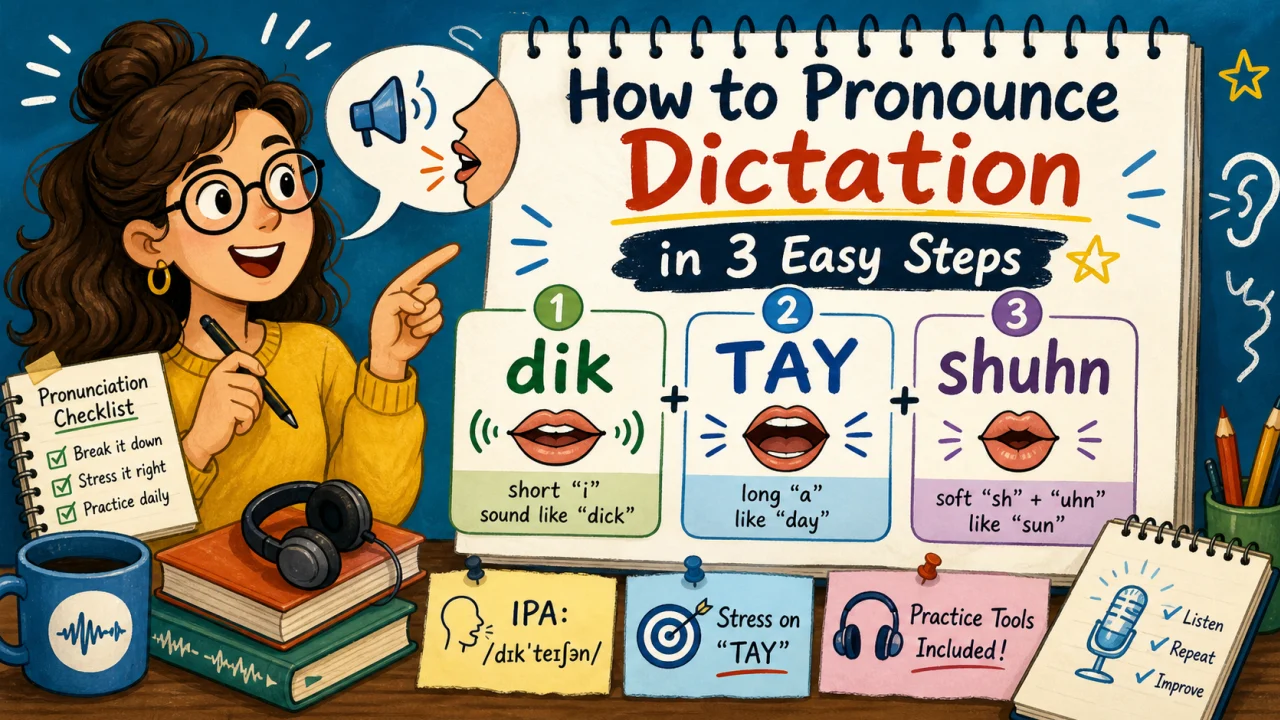
You're staring at the word "dictation" and you have no idea whether it's "dick-TAT-ee-on" or "dik-TAY-shun" or something else entirely. Here's the answer: dictation is pronounced /dɪkˈteɪ.ʃən/, which sounds like dik-TAY-shuhn. Three syllables, stress on the middle one — and every individual sound in the word already exists in everyday English.
This guide walks you through how to pronounce dictation by breaking it into three pieces you can say without thinking. No phonetics background needed.
Why "Dictation" Catches People Off Guard
The spelling is the culprit. Those eight letters make your brain want to squeeze out four syllables, maybe even five. Spanish speakers often add an extra vowel after the "t." Mandarin speakers sometimes flatten the stress so every syllable carries the same weight. And even plenty of native English speakers rush through it so fast the word turns into a mumble.
Here's the thing: the sounds themselves aren't the problem. Every single sound in "dictation" appears in common, simple English words you already say. The challenge is assembly — knowing which pieces go where and which syllable gets the punch.
The IPA Breakdown for "Dictation"
The Cambridge English Dictionary records the pronunciation as /dɪkˈteɪ.ʃən/ for both American and British English. That small mark before "teɪ" is the stress indicator — it tells you the second syllable is the one to hit hard.
What /dɪkˈteɪ.ʃən/ Looks Like in Plain English
If IPA symbols look like alien code, here's the translation using sounds you already make:
- /dɪk/ = the "dik" in "dictionary"
- /teɪ/ = the word "day" but starting with a T
- /ʃən/ = the "-tion" ending in "nation"
Three chunks. Let's practice each one.
Step 1 — Say "dik" Like the Start of "Dictionary"
Say "dictionary" out loud. Now stop right after the first syllable. That's "dik." The /d/ is the same D as in "day," the /ɪ/ is the short I sound in "ship," and the /k/ is the hard C in "cat."
Keep it quick. This syllable is unstressed, so it should feel light — almost tossed aside. Don't sit on it.
Step 2 — Say "TAY" Like "Day" With a T
This is where the action is. Swap the D in "day" for a T and you get "TAY." Say it a little louder and a little longer than the first syllable. That extra emphasis is what linguists call primary stress, and it's the single most important thing about getting this word right.
The vowel is /eɪ/ — the same sound in "make," "cake," and "late." Not a short A, not an "ah." It rhymes with "say."
Step 3 — Say "shuhn" Like the End of "Nation"
You've been saying this sound your whole life. "Nation," "station," "vacation" — they all end with "-shuhn." The /ʃ/ is the "sh" in "she," and /ən/ is the soft, quick ending you hear in "sudden."
This syllable is unstressed too. Let it fade out naturally, like the tail end of a sigh.
Put It Together: dik-TAY-shuhn
Chain the three pieces: dik (soft) + TAY (loud) + shuhn (soft). Say it slowly three times, then speed up. By the fifth or sixth repetition, it should feel natural.
A useful trick: drop "dictation" into a full sentence. Try: "The teacher gave a dictation exercise." Placing the word in a real phrase forces your mouth to move between sounds smoothly instead of treating each syllable like a separate event.
Where Does the Stress Land?
On the second syllable. Always. The rhythm is weak-STRONG-weak — the same pattern as "va-CA-tion" and "e-QUA-tion." If you walk away with only one thing from this page, make it this: hit that middle syllable harder than the other two.
Here's a non-obvious point that most pronunciation pages skip entirely: getting the stress right matters more than perfecting each individual vowel. A listener who hears "dik-TAY-shuhn" with a slightly off vowel will still understand you. But stress the first syllable — "DIK-tay-shuhn" — and the word genuinely sounds wrong. People may not even recognize it.
American vs. British Pronunciation — Any Real Difference?
Barely. The Cambridge Dictionary records the same IPA — /dɪkˈteɪ.ʃən/ — for both US and UK speakers. In practice, an American speaker might clip the final syllable a touch shorter, and a British speaker might round the vowel in "dik" very slightly. These are small differences. If you nail the three-syllable, stress-on-the-second pattern, you'll sound natural on either side of the Atlantic.
Don't overthink the accent question. The fundamentals are the same.
Common Mistakes That Make "Dictation" Sound Wrong
Stressing the First Syllable Instead of the Second
Saying "DIK-tay-shuhn" is the most frequent error. It sounds choppy and breaks the rhythm English speakers expect. Think of it this way: English "-ation" words almost always stress the syllable right before the "-ation" ending. Education, operation, information — the beat always lands just before that suffix. Dictation follows the exact same rule.
Saying "dick-TAT-ee-on" With Too Many Syllables
Four syllables instead of three. This happens when you split the "-tion" ending into two sounds — "tee" and "on" — rather than blending them into "shuhn." If you catch yourself doing this, return to Step 3 and practice the "-shuhn" ending by itself until it feels automatic.

How "Dictation" Connects to "Dictate" — The Stress Shift Worth Knowing
This one trips up even intermediate learners. The verb "dictate" is stressed on the first syllable in American English: DIK-tayt. Add the "-ation" suffix to make "dictation," and the stress jumps to the second syllable: dik-TAY-shuhn.
It's not random. English has a pattern where adding "-ation" pulls the stress forward to the syllable just before the suffix. "Explain" becomes "ex-pla-NA-tion." "Admire" becomes "ad-mi-RA-tion." Once you spot this pattern, dozens of "-ation" words get easier to say — not just "dictation."
Free Tools to Practice Saying "Dictation" Out Loud
Reading about pronunciation only gets you halfway. You need to hear it and repeat it. These three tools are free and work right in your browser.
Cambridge Dictionary Audio
The Cambridge Dictionary pronunciation page offers separate audio clips for each individual sound in the word. You can listen to /d/ as in "day," /ɪ/ as in "ship," /k/ as in "cat," and so on, then hear the full word. It's the most methodical option available.
YouGlish (466 Real Speaker Clips)
YouGlish pulls clips from real YouTube videos where someone actually says "dictation" in context. With 466 clips available, you hear the word spoken by teachers, news anchors, and everyday people — not just a single studio recording. That variety helps you understand how the word sounds in fast, natural speech.
ELSA Speak Feedback Feature
ELSA Speak lets you record yourself saying "dictation" and scores your attempt. It flags exactly which sounds are off — maybe your /eɪ/ is too short, or your stress placement is landing on the wrong syllable. It's the closest thing to having a pronunciation coach on your phone.
Key Takeaways
- Dictation is pronounced /dɪkˈteɪ.ʃən/: dik-TAY-shuhn, three syllables.
- The stress always falls on the second syllable: dik-TAY-shuhn.
- Every sound in the word exists in everyday English — "dictionary," "day," "nation."
- Getting the stress right is more important than perfecting each vowel.
- Adding "-ation" to a verb shifts the stress forward — this applies to dozens of English words beyond "dictation."
FAQ
How many syllables does "dictation" have?
Three. Dik-TAY-shuhn. A common mistake is splitting the "-tion" ending into two syllables, giving you four. Keep "-tion" as one blended sound: "shuhn."
Is "dictation" pronounced differently in British and American English?
The IPA is identical for both — /dɪkˈteɪ.ʃən/ — according to the Cambridge Dictionary. Minor rhythmic differences exist between individual speakers, but the syllable count, sounds, and stress are the same.
What does "dictation" mean?
Dictation is the act of speaking or reading aloud so someone else can write down your words. You might remember it from school spelling tests, or you may use the dictation feature on your phone to send texts hands-free.