Not sure what comes after "when" in a sentence? The confusion is real — and it's not your fault. "When" actually plays three distinct grammatical roles in English, and what follows it changes depending on which role it's filling. Nail that distinction first, and the rest falls into place.
What Comes After "When"? Start With This Table
A lot of grammar explanations jump straight to examples, leaving you more confused than when you started. The real fix is understanding which "version" of "when" you're dealing with before anything else.
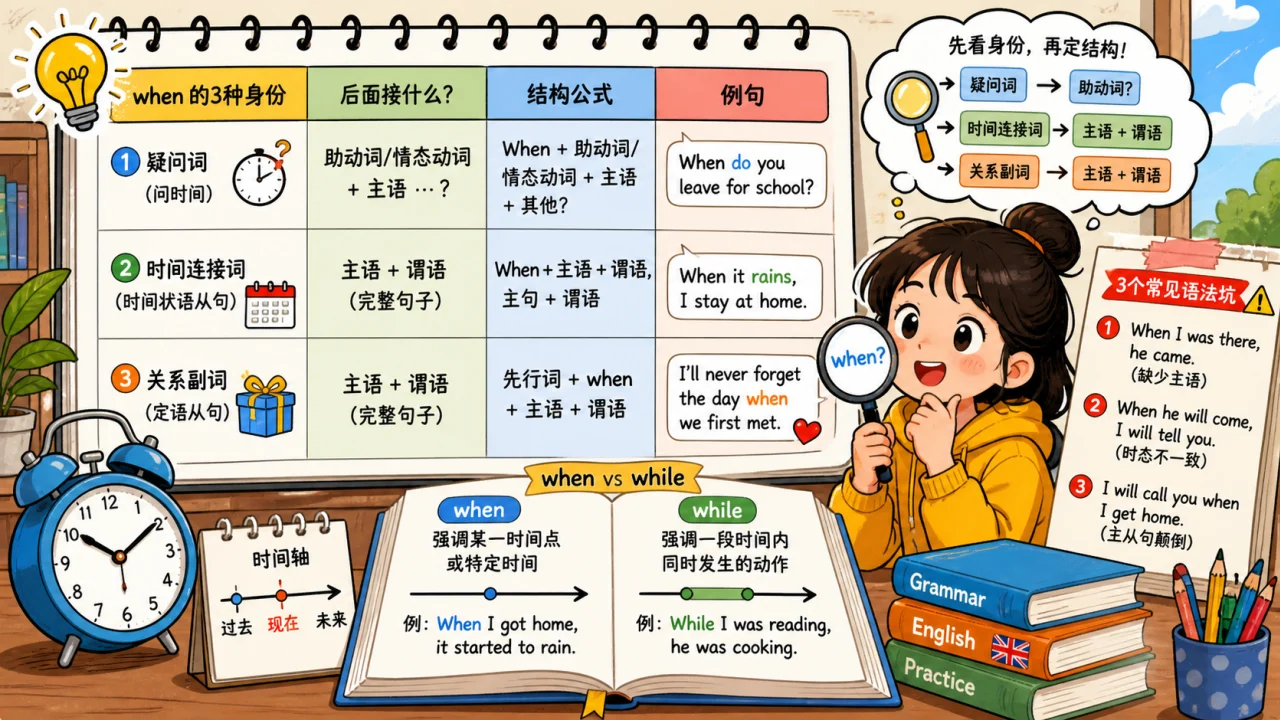
Comparison Table: What Follows "When" in Each Role
| Role of "when" | Meaning | What directly follows | Example |
|---|---|---|---|
| Question word (direct question) | At what time | Auxiliary/be verb + subject | When did you arrive? |
| Question word (indirect question) | At what time | Subject + verb (normal order) | I wonder when you arrived. |
| Time conjunction | At the time that | Subject + verb (normal order) | When I got home, he called me. |
| Relative adverb | That / on which (time) | Subject + verb (normal order) | I remember the day when we met. |
Notice the pattern: only direct questions flip the word order. In every other case, "when" is followed by a subject and then a verb — normal sentence order. Keep that in mind and you'll sidestep half the errors automatically.
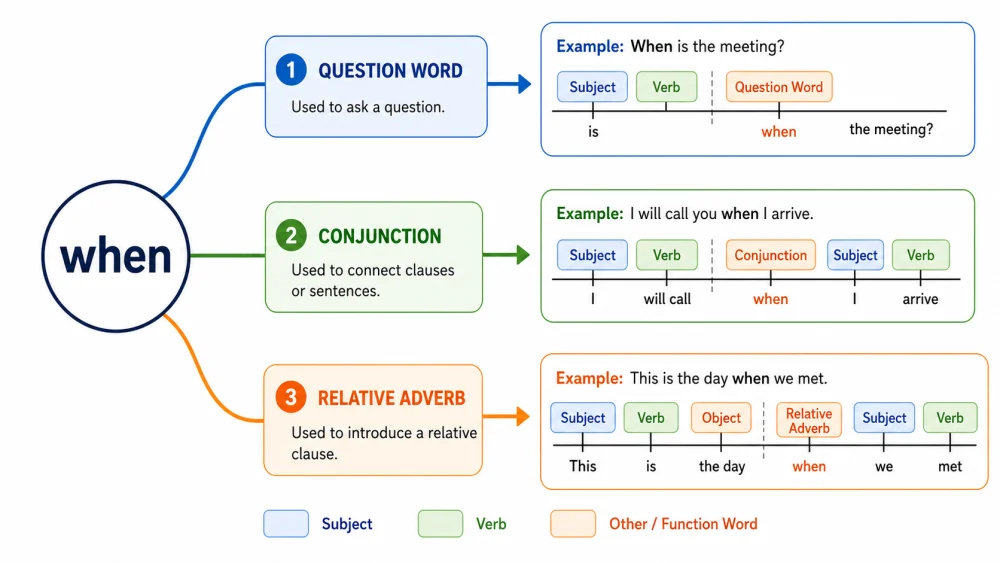
Role 1: Question Word — Asking "At What Time?"
This is the "when" you learned first. But the word-order difference between direct and indirect questions is exactly where test points hide.
Direct Questions: When + Auxiliary/Be Verb + Subject
When "when" opens a direct question, an auxiliary verb (do, did, will, can, should) or a be verb (is, are, was, were) comes immediately after it — before the subject.
- When did you leave?
- When is the exam?
- When will she come back?
Formula: When + auxiliary/be verb + subject + main verb / rest of sentence?
Indirect Questions: Why Does the Word Order Flip Back?
When you embed a "when" question inside another sentence, it becomes an indirect question. The word order resets to normal: subject first, then verb.
Direct: When can I pick up my order? Indirect: Could you tell me when I can pick up my order?
Compare the two: the direct question has "can I," but the indirect question has "I can." That flip trips up a lot of learners, especially on standardized tests where this exact structure appears repeatedly.
Role 2: Time Conjunction — "At the Time That"
As a conjunction, "when" links two events by time. Which tense you use depends on the nature of those two events.
Two Instantaneous Actions: Both in Simple Past
If both actions happen in an instant — things like arriving, calling, or turning off a light — both clauses use simple past.
- When the teacher appeared at the door, the students went quiet.
- When I got home, he called me.
These two actions happen almost simultaneously, with virtually no gap between them.
One Ongoing Action + One Sudden Action
When one action is already in progress and another interrupts it, use past progressive for the ongoing action and simple past for the interruption.
- When Mom got home, I was doing my homework.
- I was walking to the store when it started to rain.
One detail worth noting: the "when" clause can go first or last without changing the meaning. When it comes second, drop the comma.
Describing a Life Stage or Period
"When" can also frame a life stage or extended stretch of time. The main clause then describes what was typical or true during that period.
- When I was in high school, I used to play guitar every day.
- She got her driver's license when she was 17.
You'll notice the "when" clause usually stays in simple past here, while the main clause can use used to, simple past, or past progressive depending on what you're describing.
Role 3: Relative Adverb — Modifying a Time Noun
"When" has a third job: acting as a relative adverb that introduces a clause modifying a noun related to time.
Which Antecedents Work With Relative "When"?
The noun before "when" — called the antecedent — must refer to time. Common ones: the day, the year, the moment, the night, the month, the time.
- I still remember the summer when we drove across the country.
- Saturday is the day when he usually goes running.
If the antecedent refers to a place (the place) or a reason (the reason), you need "where" or "why" instead. "When" won't work.
When Can You Drop "When"? (Most Guides Skip This)
Here's something most textbooks don't mention: when the antecedent is a general time noun like "the time" or "the day," you can omit "when" — and sometimes you can drop the antecedent too.
- I remember the day (when) we first met. → Correct; "when" is optional.
- This is the place when I grew up. → Wrong; the antecedent is a place, so "when" doesn't belong here.
If the antecedent is a specific date — say, "March 14th" or "1969" — keeping "when" tends to sound more natural than dropping it. This rule rarely shows up on grammar tests, but handling it well in writing makes your English feel noticeably more fluent.
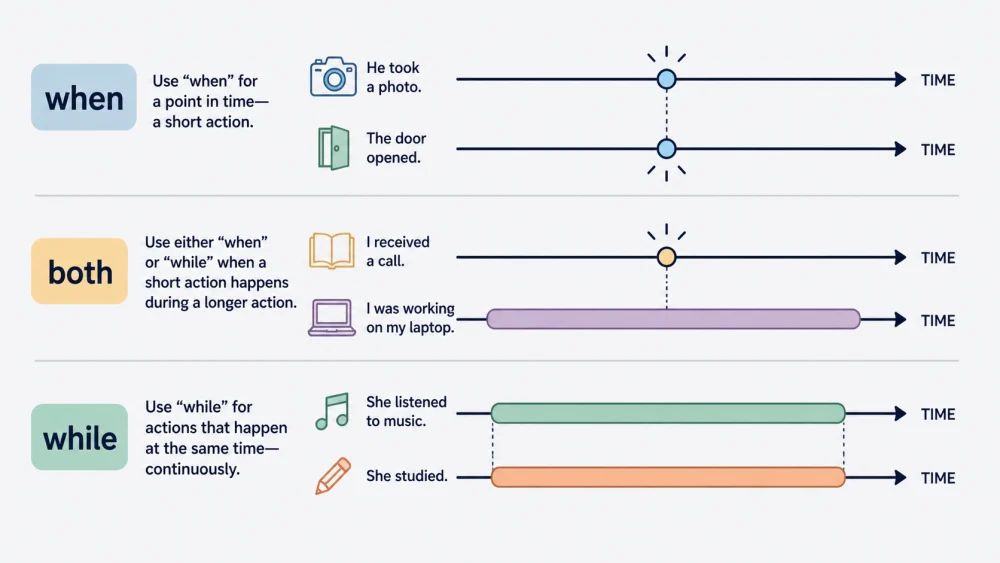
When vs. While: One Question Decides It
"When vs. while" is the most-searched follow-up question about this topic — and it has a clean answer. Ask yourself: is the verb action instant or ongoing?
Instant vs. Ongoing: The Core Distinction
Instant verbs describe actions that are over in a moment: arrive, start, knock, open. Ongoing verbs describe actions that stretch over time: study, watch, walk, sleep.
- Both verbs instant → use "when" only
- Both verbs ongoing → use "while" only
- One ongoing + one instant → either works (details below)
Examples:
- When I got home, he called. (Both instant — "when" only)
- She was cooking while he was cleaning. (Both ongoing — "while" only)
The One Case Where They're Interchangeable
When a past progressive action (ongoing) gets interrupted by a simple past action (instant), you can use either word.
- When/While I was taking a shower, the power went out.
Both are grammatically correct here. "While" emphasizes the duration — "during that stretch of time." "When" points to the moment of interruption. The difference is subtle, so don't stress over it.
5 Tense Combinations With "When": Real Examples You Can Practice
Rules only stick when you see them in action. Here are the five pairings that come up most in writing and on tests.
Simple Present + When + Simple Present
Describes habits or natural rules.
- It gets cold when the wind picks up.
- He smiles when you compliment him.
Past Progressive + When + Simple Past
An ongoing action gets interrupted.
- I was reading when someone knocked on the door.
- We were having dinner when the fire alarm went off.
Past Perfect + When + Simple Past
One action was already finished before the other happened.
- I had already finished my homework when Dad got home.
- The train had left when we reached the station.
3 Mistakes Learners Make With "When"
Mixing Up "When" and "If"
"When" can sometimes translate as "if" in other languages, but they mean different things in English. "When" implies the event will definitely happen (or already does). "If" signals uncertainty.
- When it rains, I bring an umbrella. (It rains regularly — implied certainty.)
- If it rains, I'll bring an umbrella. (Not sure whether it will rain.)
Using "when" where "if" belongs makes a statement sound overly certain.
Inverting Word Order in Indirect Questions
This is one of the most common test errors. Learners see "when" and instinctively write an inverted question structure — even inside an indirect question. The result: "I don't know when did he come." The correct version restores normal order: I don't know when he came.
Using "Will" Inside a "When" Time Clause
English has a firm rule: in a time clause introduced by "when" acting as a conjunction, you use simple present instead of "will" — even when the sentence refers to the future.
- Wrong: When I will arrive, I will call you.
- Right: When I arrive, I will call you.
This rule applies only when "when" is a time conjunction. If "when" is a question word — as in "I don't know when he will come" — using "will" is perfectly fine. Keeping these two uses separate is the key to getting this right consistently.
Key Takeaways
- "When" has three roles: question word, time conjunction, and relative adverb. Identify the role first.
- Only direct questions require inverted word order after "when." Everything else uses normal subject-verb order.
- In time clauses with "when" as a conjunction, use simple present for future events — never "will."
- Choose "while" for two simultaneous ongoing actions; use "when" for instant actions. Either works when a progressive action is interrupted.
- As a relative adverb, "when" follows time nouns only — not places or reasons.
FAQ
Can "when" be followed by a verb ending in -ing?
Yes, but only as a shortened form of a full clause. "When walking home" is a reduction of "When I was walking home" — the subject and be verb are dropped. This shortening only works when the subject of the "when" clause and the main clause are the same person.
Is "when" a relative pronoun or a relative adverb?
It's a relative adverb. Relative pronouns (who, which, that) act as the subject or object inside their clause. Relative adverbs (when, where, why) act as modifiers — they indicate time, place, or reason within the clause, not a participant in the action.
What's the difference between "when" and "as" for simultaneous events?
"As" suggests two actions unfolding together with a sense of progression or change — "As I got older, I understood more." "When" simply marks a point or period in time without that sense of gradual shift. If you're describing two things changing in parallel, "as" is the more precise choice.