If you looked up the dictation meaning in English and came back with a pile of overlapping definitions, you're not alone. Here's the short answer: dictation is a noun (pronounced /dɪkˈteɪ.ʃən/) with 3 distinct senses, each appearing in completely different situations. Use the wrong one, and your sentence says something you didn't mean.
What Does Dictation Actually Mean in English?
The word comes from the Latin verb dictare, meaning both "to say repeatedly" and "to impose one's will." That double origin is exactly where the confusion starts. English picked up the word in the 15th century, and over time it split into 3 separate definitions — ones that dictionaries like Merriam-Webster and Cambridge still list individually.
Let's break each one down so you can spot the right meaning on sight.
Definition 1 — Speaking So Someone Else Can Write It Down
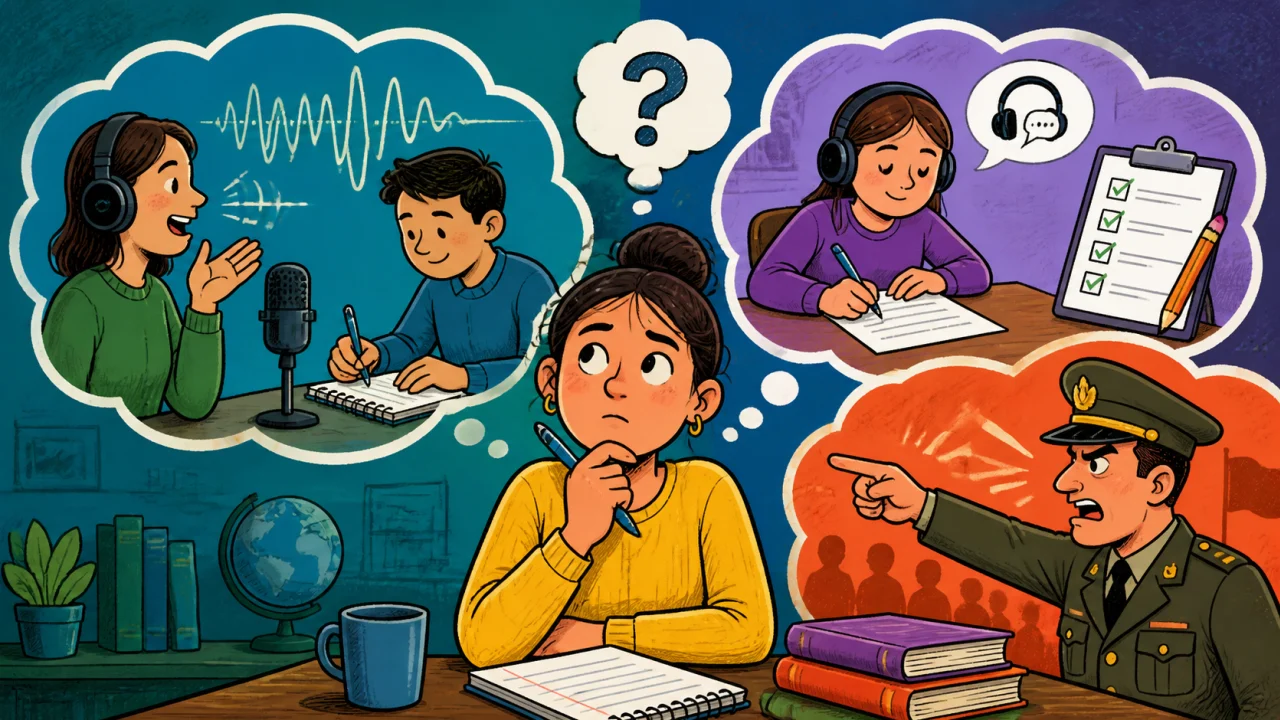
This is the sense you'll run into most often. Dictation here means saying words aloud so another person — or a piece of software — can write them down.
Picture a lawyer speaking a client letter into a voice recorder during the commute home. That recording goes to an assistant or speech-recognition app, and the spoken words become a typed document. That entire process is dictation.

The phrase "take dictation" belongs here. When someone takes dictation, they're the one writing — not speaking. If your boss asks, "Can you take dictation for me?" she's asking you to open a document and type what she says, not the other way around.
One wrinkle people miss: the finished text is also called a dictation. You can say, "I recorded a dictation this morning" and mean the audio file, or say, "The dictation is ready for review" and mean the typed document. Context carries the weight.
According to Collins Dictionary, this sense covers "the speaking or reading aloud of words for someone else to write down." Clear enough — until you meet the next definition.
Definition 2 — A Classroom Test of Listening and Spelling
If you took a foreign language class in an American high school, you probably sat through at least one dictation exercise. The teacher reads a passage aloud — sometimes twice — and you write down every word exactly as you hear it.
This isn't just a spelling drill. A dictation exercise checks three things at once: whether you can hear words correctly, whether you can spell them, and whether you catch grammar details like verb endings or accent marks. The Cambridge Dictionary gives the example of a French dictation lasting half an hour — and anyone who's sweated through one knows that 30 minutes feels considerably longer.

Here's a grammar detail worth locking in: in this sense, dictation is a countable noun. You can say "We had two dictations this week" or "That was a hard dictation." In Definition 1, dictation is usually uncountable — you'd say "He was doing dictation," not "He was doing a dictation." It's a small distinction, but it matters in formal writing.
Definition 3 — An Order or Command (the One People Forget)
This is the meaning that trips up even fluent English speakers. Dictation can mean an authoritative direction — an order someone expects you to follow without debate.
You'd see it used like this: "The small nation refused to accept the dictation of its larger neighbor." Or: "She resented the dictation of corporate headquarters over how she ran her local office."
The connection to "dictator" isn't a coincidence. Both words grow from that same Latin root, dictare, in its second sense — imposing your will. Merriam-Webster actually lists this as the first sense of dictation, calling it "prescription" and "arbitrary command." Yet most blog posts and study guides skip it entirely.
Why does that matter? Because if you're reading a historical text or a political essay and you see "dictation" with no mention of speaking or writing, the author means a command, not a transcription exercise. Knowing this can save you from misreading an entire paragraph.
How to Tell Which Meaning Someone Intends
You don't need to memorize rules. Just ask one question when you see "dictation" in a sentence:
Is someone speaking for transcription? Look for clues like "take dictation," "record," "transcribe," or references to an assistant, recorder, or software. That's Definition 1. Example: "He finished his dictation and handed the tape to his secretary."
Is a teacher testing students? Watch for words like "exercise," "test," "classroom," "spelling," or a specific language name. That's Definition 2. Example: "The Spanish dictation covered 3 pages of vocabulary from Chapter 6."
Is someone giving orders or setting conditions? Look for words like "accept," "refuse," "follow," "under the dictation of," or references to authority and power. That's Definition 3. Example: "They acted under the dictation of the party chairman."
The surrounding words almost always give it away.
Dictation vs. Dictate vs. Transcription — Words That Trip You Up
These three terms overlap just enough to cause problems.
Dictation is a noun. It's the act of speaking to be recorded, the classroom test, or an authoritative command.
Dictate is primarily a verb — "I'll dictate the memo." But it's also a noun with a different meaning: a guiding principle or rule. "The dictates of fashion" means the rules fashion imposes, not someone speaking into a recorder.
Transcription refers specifically to the written output. When you speak, that's dictation. When the words land on paper or screen, the document is a transcription. The two words sit at opposite ends of the same process.
Where You'll Hear Dictation Used Today
In Offices and Legal Work
Lawyers, doctors, and executives still dictate memos, case notes, and patient records daily. The method has shifted — handheld recorders and speech-recognition software have replaced the secretary with a steno pad — but the word hasn't changed.
In Language Classes and Spelling Bees
American schools use dictation exercises in Spanish, French, and ESL classes. Spelling bees run on a similar principle: an announcer says a word, and the contestant must reproduce it letter by letter.
In Political and Historical Writing
You'll find the "command" sense in older American political writing, diplomatic history, and editorial commentary. Phrases like "under the dictation of" or "resisting foreign dictation" carry real weight in those contexts, and they have nothing to do with microphones or recordings.
Common Mistakes When Using Dictation in a Sentence
Confusing dictation with diction. These are different words. Diction refers to word choice or clarity of pronunciation — "The actor's diction was excellent." Dictation is about speaking for someone to write down, or issuing a command. Swap them, and your sentence stops making sense.
Using dictation as a verb. "I will dictation a letter" is wrong. Dictation is a noun. The verb form is dictate. Say "I will dictate a letter."
Mixing up "take dictation" and "give dictation." The person who speaks gives dictation. The person who writes takes dictation. If you tell someone "I'll take dictation from you," you're offering to write — not to talk.
FAQ
What is an example of a dictation?
A manager speaks a business letter aloud while an assistant types every word. Both the spoken act and the resulting document are called a dictation. In a classroom, a teacher reading a French paragraph for students to transcribe is also a dictation.
What is another word for dictation?
For the transcription sense, close synonyms include transcription (loosely) and recorded speech. For the command sense, Vocabulary.com lists command, bidding, and direction as near equivalents.
What is the difference between dictation and diction?
Dictation is the act of speaking so someone else can write your words down, or an authoritative command. Diction means the choice and use of words in speech or writing, or the clarity of someone's pronunciation. They share a Latin ancestor but mean entirely different things.
How do you pronounce dictation in American English?
It's pronounced /dɪkˈteɪ.ʃən/ — four syllables, stress on the second: dic-TAY-shun.