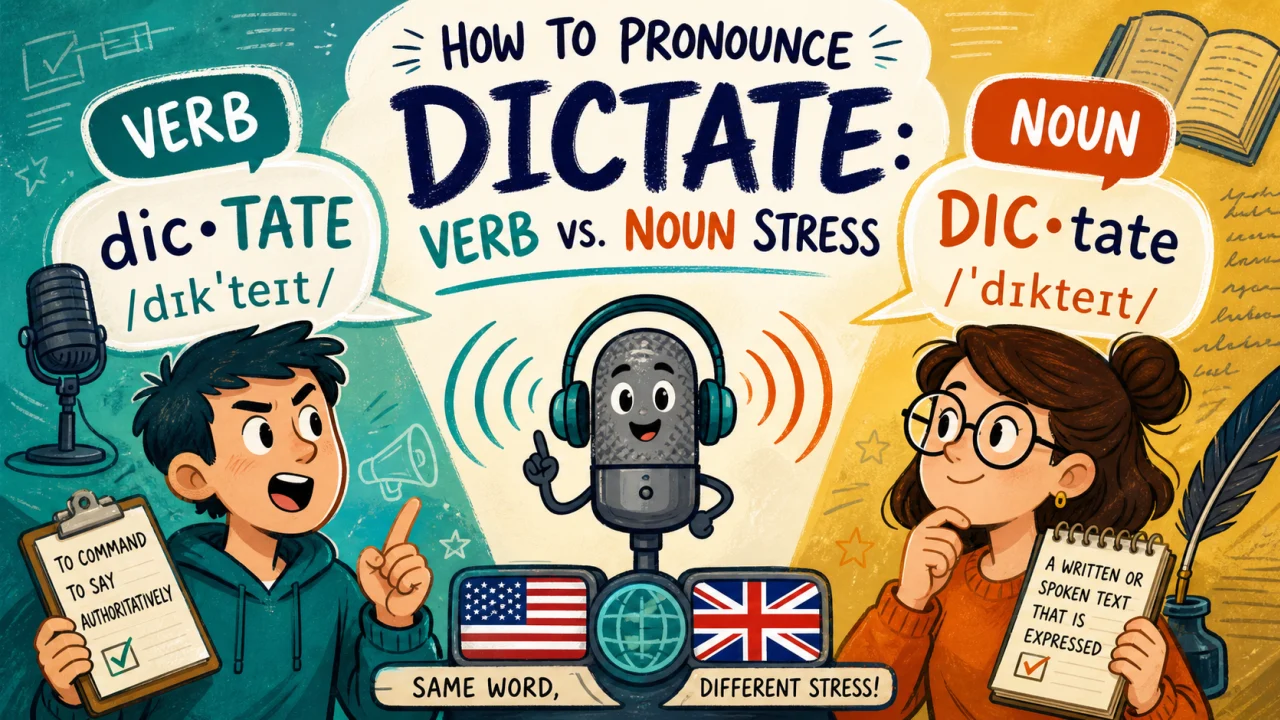
You've probably paused mid-sentence, unsure whether to stress the first or second syllable of "dictate." Here's the short answer: in American English, both the verb and noun are pronounced DIK-tayt (/ˈdɪk.teɪt/), with the stress on the first syllable. British English handles the verb differently — and that's exactly where the confusion kicks in.
This guide breaks down how to pronounce dictate as both a verb and a noun, explains why the stress shifts depending on dialect, and gives you a pattern that applies to dozens of similar English words.
How to Pronounce Dictate in American English
The Quick Answer — Say It Like DIK-tayt
Two syllables. Stress on the first one. Think of "dik" rhyming with "tick," and "tayt" rhyming with "late."
If you're speaking American English, this works whether you're using dictate as a verb ("I'll dictate the letter") or as a noun ("the dictates of fashion"). The Cambridge Dictionary lists the American English pronunciation as /ˈdɪk.teɪt/ for both forms.
That's the whole answer if you needed a quick fix. But if you want to understand why this word trips people up — and how to stop second-guessing it — keep reading.
IPA Breakdown Sound by Sound
The International Phonetic Alphabet makes it precise:
- /d/ — like the "d" in "day"
- /ɪ/ — the short vowel in "ship," not the long "ee" in "see"
- /k/ — a hard "k" as in "cat"
- /t/ — a clean "t" as in "town"
- /eɪ/ — the diphthong in "day" or "late"
- /t/ — another "t" to close it out
Six sounds, two syllables. The stress mark (ˈ) sits before "dɪk," marking it as the louder, punchier syllable.
Verb vs. Noun — Why the Stress Moves
Here's the detail most pronunciation pages skip entirely: "dictate" doesn't behave the same way across every English dialect. The verb form is where the split happens.
Dictate as a Verb: Where British and American English Part Ways
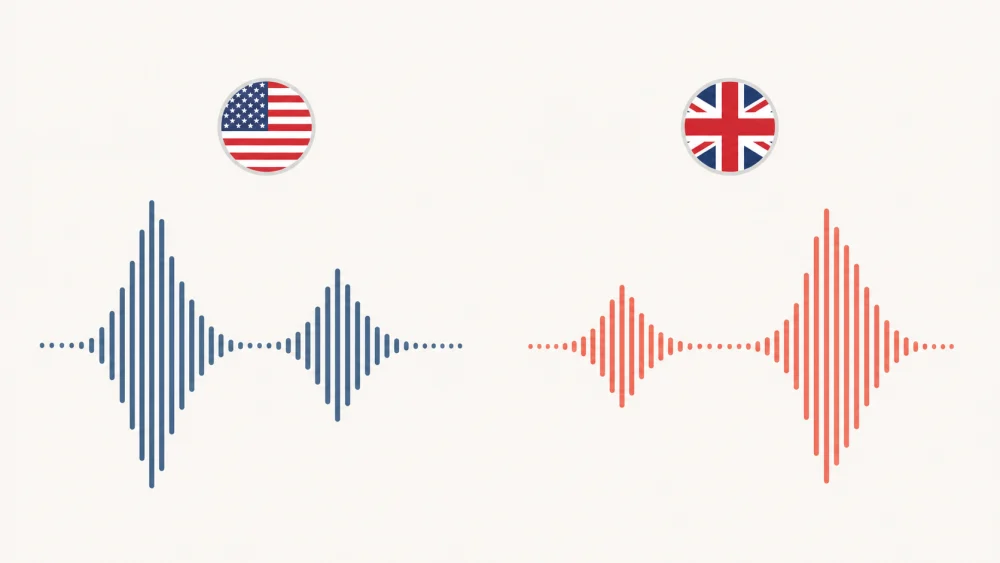
American speakers stress the first syllable for the verb: DIK-tayt (/ˈdɪk.teɪt/).
British speakers tend to flip that, stressing the second syllable instead: dik-TAYT (/dɪkˈteɪt/). The Cambridge Dictionary confirms this UK verb pronunciation with a separate IPA entry.
So if you've watched a British film and thought the actor said the word differently than your American colleague does, you weren't imagining it. Both pronunciations are correct within their respective dialects. Neither is "wrong."
This is actually the under-discussed takeaway here: there's no single correct way to pronounce the verb form of dictate in English. The right choice depends entirely on which side of the Atlantic you're on. Giving a presentation in New York? Stress syllable one. Presenting in London? Syllable two won't raise a single eyebrow.
Dictate as a Noun: First-Syllable Stress, Every Time
The noun form — used in phrases like "the dictates of conscience" — gets first-syllable stress in both American and British English: /ˈdɪk.teɪt/.
This is actually the simpler case. No matter where you are, the noun sounds the same. The dialect split only shows up in the verb.
The Stress-Shift Pattern You Can Use for Other Words
Record, Permit, and Contract Follow the Same Rule
English has a well-known pattern where two-syllable words shift stress depending on whether they function as a noun or a verb. The noun gets first-syllable stress; the verb gets second-syllable stress — at least in the standard pattern.
Three clear examples:
- Record: RE-cord (noun) vs. re-CORD (verb)
- Permit: PER-mit (noun) vs. per-MIT (verb)
- Contract: CON-tract (noun) vs. con-TRACT (verb)
"Dictate" partially follows this pattern in British English, where the verb shifts stress to the second syllable. American English flattens that distinction — both noun and verb land on the first syllable. That's why American speakers sometimes don't even realize the stress shift exists. If you learned English primarily from American TV or podcasts, you'd never hear it.
Knowing this pattern gives you a useful shortcut. The next time you hit a two-syllable word that works as both a noun and a verb, try first-syllable stress for the noun and second-syllable stress for the verb. You'll be right more often than not.
Common Mistakes When You Say Dictate Out Loud
Swallowing the K Sound Between Syllables
The /k/ in "dictate" sits at the end of the first syllable, right before the /t/ that opens the second. Two stop consonants back to back — and your mouth naturally wants to drop one. The /k/ usually loses.
When that happens, "dictate" starts sounding like "dih-TAYT" — mushy and unclear. The fix: briefly hold the /k/ at the back of your throat before releasing into the /t/. No big pause needed. Just don't let the two sounds blur into one.
Giving Both Syllables Equal Weight
Flat stress — the same emphasis on both syllables — makes "dictate" sound robotic. English is a stress-timed language, which means listeners rely on stress patterns to parse words quickly. When every syllable gets equal weight, the word actually becomes harder to follow, not easier.
Pick a syllable and commit to it. In American English, punch the first one.
How to Practice Until It Feels Natural
A Simple 30-Second Drill You Can Do Anywhere
Say these three words in a row, exaggerating the first-syllable stress each time:
- DIC-tate
- DIC-tion
- DIC-tionary
Notice how the stress anchors to that first syllable across the whole word family? Run through this sequence 5 times at a normal pace. By the third round, your mouth starts finding the rhythm on its own.
Sentence Pairs That Lock In the Right Stress
Read each pair aloud — not just in your head:
-
"Don't dictate the rules to me." (verb)
-
"She refused to follow the dictates of tradition." (noun)
-
"He'll dictate a memo after lunch." (verb)
-
"The dictates of good taste kept him quiet." (noun)
In American English, the stress lands on "DIC" in every one of these. If you're practicing British pronunciation for the verb, shift the stress to the second syllable: "dik-TATE the rules to me."
Reading these sentences aloud makes the difference. Your mouth needs the repetitions.
Dictate, Dictation, Dictator — How the Word Family Sounds
Once you've got "dictate" down, the related words fall into place:
- Dictation (/dɪkˈteɪ.ʃən/) — 3 syllables, stress on the second. The "-tion" ending always pulls stress to the syllable right before it.
- Dictator (/ˈdɪk.teɪ.tər/) — 3 syllables in American English, stress on the first. The "-or" ending doesn't shift anything.
- Dictatorial (/ˌdɪk.təˈtɔːr.i.əl/) — 5 syllables, primary stress on the third. It's a mouthful, but the root "dicta-" stays recognizable throughout.
"Dictation" deserves special attention because it's the one word in this family that actually shifts stress away from the first syllable. If you can say "DIC-tate" and then "dic-TA-tion" without stumbling, you've got the whole family handled.
FAQ
Is it wrong to stress the second syllable of dictate in American English?
Not wrong, but it's unusual. The Cambridge Dictionary lists /ˈdɪk.teɪt/ as the standard American pronunciation for both the verb and noun. If you stress the second syllable in an American context, you'll still be understood — but listeners may assume you're British or that you learned English from non-American sources.
How do you say "dictates" when it ends in S?
The same way, with a /s/ added at the end: DIK-tayts (/ˈdɪk.teɪts/). The stress doesn't move. Whether it's a third-person verb ("she dictates") or a plural noun ("the dictates"), the first syllable still carries the weight.
Does dictate have 2 or 3 syllables?
Two. DIC-tate. Some people hear 3 syllables because of the /k/ and /t/ cluster in the middle, which can create a tiny pause that sounds like an extra syllable. But both Cambridge and Britannica confirm it's a 2-syllable word.