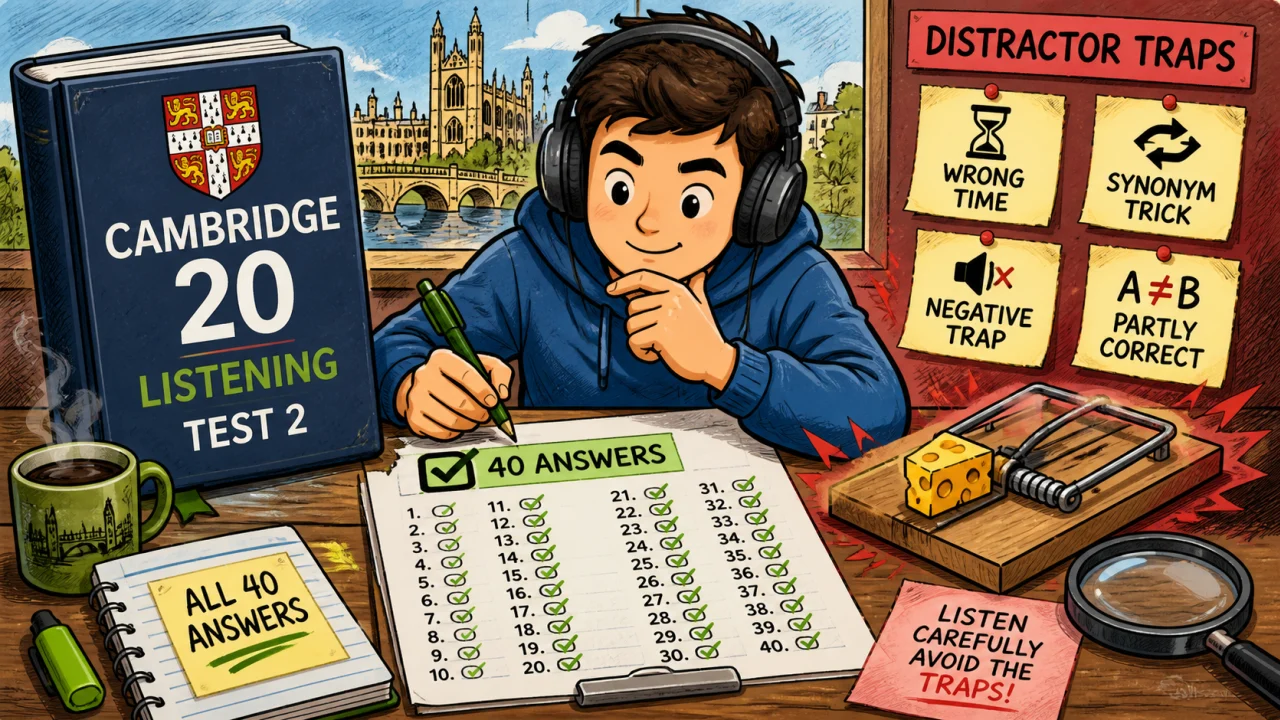
You heard the answer. You're confident you heard it. Then your score says otherwise. That's the defining frustration of Cambridge 20 Listening Test 2—a test where the examiners plant distractors so precisely that strong listeners drop marks not because they missed words, but because they wrote down the wrong ones. This breakdown covers all 40 answers across the four parts and identifies the specific traps designed to cost you points.
Why Cambridge 20 Listening Test 2 Catches Even Strong Listeners Off Guard
This test isn't just checking whether you can hear English. It's checking whether you can resist writing down the first plausible thing a speaker says before the conversation corrects course. The topics move from an everyday caregiving conversation to a volunteer scheme monologue, then into a two-person academic discussion, and finally a dense lecture on food trends. Each part uses a different tactic to mislead you.
The 4-Part Structure of This Test
- Part 1 (Questions 1–10): A conversation about council support for someone caring for an elderly parent. Gap-fill format—one word and/or a number per blank.
- Part 2 (Questions 11–20): A monologue by a volunteer coordinator from Elmley Town Council. Matching plus multiple choice.
- Part 3 (Questions 21–30): Two students, Rosie and Colin, discuss human geography topics. Matching opinions plus multiple choice.
- Part 4 (Questions 31–40): A lecture on developing food trends and marketing campaigns. One-word gap-fill.
How Your Raw Score Out of 40 Converts to a Band Score
Here's a quick reference so you know where you stand: 30–31 correct gives you Band 7.0, 35–36 correct lands Band 8.0, and you need 39–40 for a 9.0. If you're targeting Band 7, you can technically miss 9–10 questions—but this test has at least 6 questions where the distractor sounds more natural than the real answer. That margin disappears fast.
Part 1 Answers (Questions 1–10): Caring for an Elderly Parent
Correct Answers at a Glance — break, time, shower, money, memory, lifting, fall, taxi, insurance, stress
Full list: 1) break, 2) time, 3) shower, 4) money, 5) memory, 6) lifting, 7) fall, 8) taxi, 9) insurance, 10) stress.
The conversation is between a woman who left her job to care for her mother and a male friend explaining what the local council can provide. The format calls for one word and/or a number per blank.
The Synonym Swap Trap in Questions 4 and 5
Question 4 asks about a task the mother struggles with. The woman says her mother "used to be very good at it, but not anymore"—referring to handling money. The trap? The conversation also mentions shopping and meals around the same moment. If you're filling gaps quickly, you might grab "shopping" because it already appears in the question stem and feels connected. But the blank specifically needs the thing that's become a problem: money.
Question 5 works the same way. The woman describes her mother forgetting to eat and losing track of what day it is. Both details point toward memory loss, but neither the word "memory" nor "forget" appears in the question wording. You have to connect the examples to the concept yourself.
Why 'taxi' Trips You Up When She Says She Drives
Question 8 is sneaky. The man mentions taxi costs as an example of transport support the council can offer. The woman immediately replies, "I usually drive her myself." A lot of test-takers hear "drive" and write something car-related—petrol, maybe. But the blank is asking for the council's example of transport support, and the man's example is taxi. The woman's reply about driving leads to Question 9 (insurance), not Question 8.
Part 2 Answers (Questions 11–20): Elmley Town Volunteer Scheme
Matching Questions 11–16: D, I, H, E, A, B — and the Distractors Behind Each
This section is a monologue from Steve Wainwright of Elmley Town Council. He describes six volunteer activities, and you match each to a role from a list of nine options. Three options go unused—and those three exist purely to distract you.
The answers: 11) D (giving advice to visitors), 12) I (helping people find their seats), 13) H (encouraging cooperation between local organisations), 14) E (collecting feedback on events), 15) A (providing entertainment), 16) B (providing publicity about a council service).
The trickiest match is Question 14. The speaker discusses a town magazine paid for by local businesses. You might jump to C (contacting local businesses), but the council's advertising department handles that side. Volunteers collect reader feedback and send it to editors. That's E.
Question 17: The Science Festival Needs the Most Volunteers, Not the Music Festival
This is where the test bets on your instincts failing you. The speaker says the music festival runs a full week and needs more volunteers than the three-day book festival. Then he says the science festival needs even more help despite being only two days long, because it uses quite a lot of venues. Your gut says a week-long event needs the most people. The answer is B—the science festival.
Questions 18–20: Dates and Events That Sound Alike
Question 18 asks about the most important requirement for festival volunteers. The speaker mentions flexibility and personal interest, then says what's "essential" is getting on well with people and handling difficult behavior. That's interpersonal skills—answer A.
For Question 19, three September dates come up fast: training starts September 2nd, duties begin from the 9th, and feedback sessions happen the week of September 23rd. "Start working" matches the 9th—answer B. Question 20's annual volunteer event is a canal boat trip (A), not the barbecue from last year or the party from years prior.
Part 3 Answers (Questions 21–30): Rosie and Colin on Human Geography
Correct Answers — D, G, B, A, E, C, A, A, B, C
Full list: 21) D, 22) G, 23) B, 24) A, 25) E, 26) C, 27) A, 28) A, 29) B, 30) C.
The Two-Speaker Problem: Tracking Who Agrees With What
Part 3 gets hard because Rosie and Colin sometimes disagree before arriving at a shared opinion. The questions ask what they both think. If you write down Rosie's first reaction without waiting for Colin's response—or vice versa—you'll choose the wrong letter. Hold your pen until both speakers have weighed in on each sub-topic before you commit.
Question 28's 'Unexpected Costs' Trap — Why Both Other Options Sound Right
The students discuss developing disused industrial sites. You hear mention of environmental damage and old buildings. Both sound like valid concerns, pointing toward options B and C. But what they actually agree on is that redevelopment "may have unexpected costs" (A). The other two points come up in passing without both students endorsing them as the main issue.
Part 4 Answers (Questions 31–40): The Food Trends Lecture
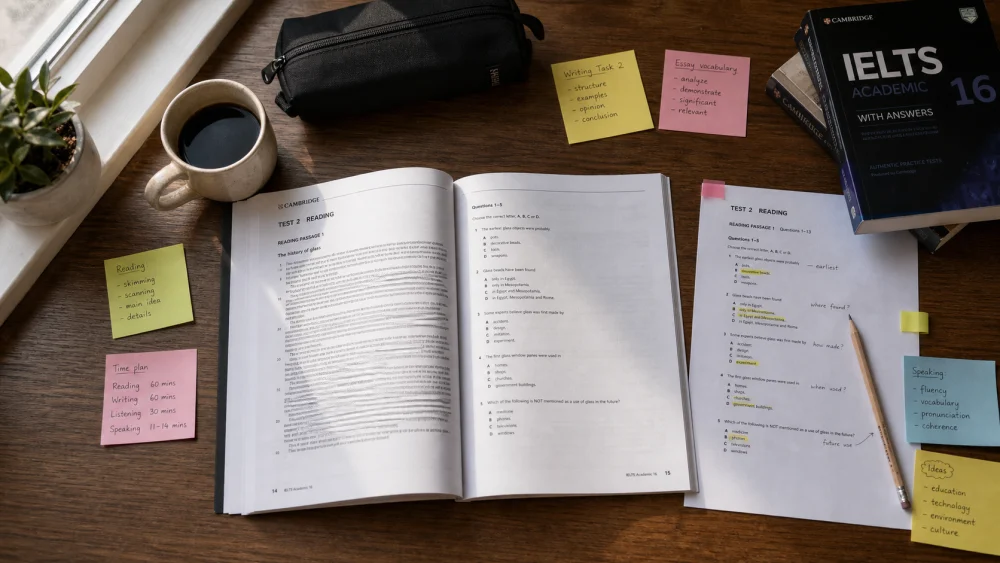
Correct Answers — photos, vegan, chefs, journalists, health, coffee, environment, reputation, price, soil
Full answers: 31) photos, 32) vegan, 33) chefs, 34) journalists, 35) health, 36) coffee, 37) environment, 38) reputation, 39) price, 40) soil.
Words You Need to Spell Correctly or Lose the Mark
Part 4 requires exactly one word per gap, and spelling counts on every answer. "Journalists" trips people up—double-check that second "a." "Environment" needs all four syllables on paper, not the three most people use in casual speech. "Reputation" is another long word where a dropped letter costs you the point outright.
Question 36: Why 'coffee' Feels Too Simple but Is Correct
The lecture explains how a Swedish oat milk brand promoted itself in the U.S. through coffee shops instead of traditional advertising. When you're listening for a marketing strategy, "coffee" feels almost too ordinary. But the blank sits right before "shops" in the sentence, and coffee is the answer. Don't overthink single-word gaps—the simplest word that fits grammatically is almost always right.
The Mistake Nobody Talks About: Losing Marks to Word Limits, Not Listening Skills
ONE WORD ONLY vs. ONE WORD AND/OR A NUMBER — Know Which Section Uses Which
Part 1 allows one word and/or a number. Parts 3 and 4 require one word only. If Part 4 asks for a single word and you write "coffee shops," that answer is marked wrong—even though the meaning is right. This isn't a listening mistake. It's a reading-the-instructions mistake, and it costs test-takers 2–3 marks across a single sitting.
Capitalization, Hyphens, and Plurals That Get Marked Wrong
IELTS accepts both uppercase and lowercase in gap-fill answers, so capitalization won't sink you. But plurals matter. "Photo" when the answer is "photos" is marked incorrect. Writing "oat-milk" as a hyphenated compound when the answer key expects a single word costs you the point. Stick to exactly what fits the grammar of the sentence in the question sheet.
How to Use This Test for Real Score Improvement Instead of Just Checking Answers
Go Back to the Audio and Pause at the Distractor Moment
Checking your answers against a key tells you what you got wrong. It doesn't tell you why. Return to the audio for every question you missed and find the exact moment where the distractor appears, then the exact moment where the real answer follows. That window—usually 5 to 15 seconds—is where your score actually lives.
Build a Personal Error Log by Question Type
After finishing Cambridge 20 Listening Test 2, write down whether each mistake was a distractor trap, a spelling error, a word-limit violation, or a case where you simply didn't catch the word. Most test-takers find that one category accounts for more than half their errors. Fix that category first, and your score can jump without any improvement to your underlying English level.
FAQ
What is the hardest part of Cambridge 20 Listening Test 2?
Part 3 gives most test-takers the most trouble. Rosie and Colin discuss five human geography topics in quick succession, and you have to track both opinions before choosing a single letter. The matching format in Questions 21–25 combined with two voices produces the highest error rate in the test.
Can I use Cambridge 20 Listening Test 2 answers in PDF format for practice?
The answer keys are available through several IELTS practice platforms that host Cambridge 20 materials. For the best results, take the test under timed conditions with audio before checking answers—reading the key cold defeats the purpose.
How is Cambridge 20 Listening Test 2 different from Test 1?
Test 2 leans more heavily on matching-style questions in Parts 2 and 3 compared to Test 1. The Part 4 topic—food trends and marketing—also uses more specialized vocabulary than a typical Part 4 lecture, which makes the gap-fill harder even though the question format is standard.
What band score does a 30 out of 40 give you?
A raw score of 30–31 out of 40 typically converts to Band 7.0. That means you can miss 9–10 questions and still hit the threshold most U.S. universities and immigration programs require.