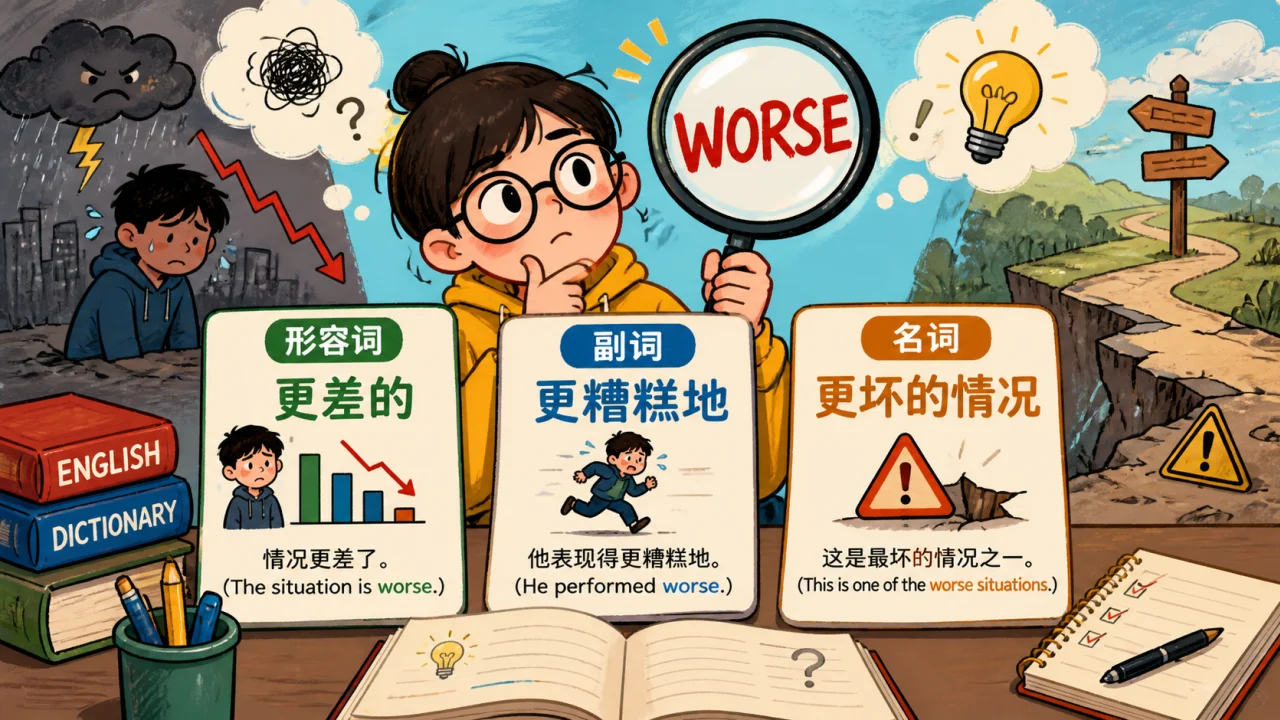
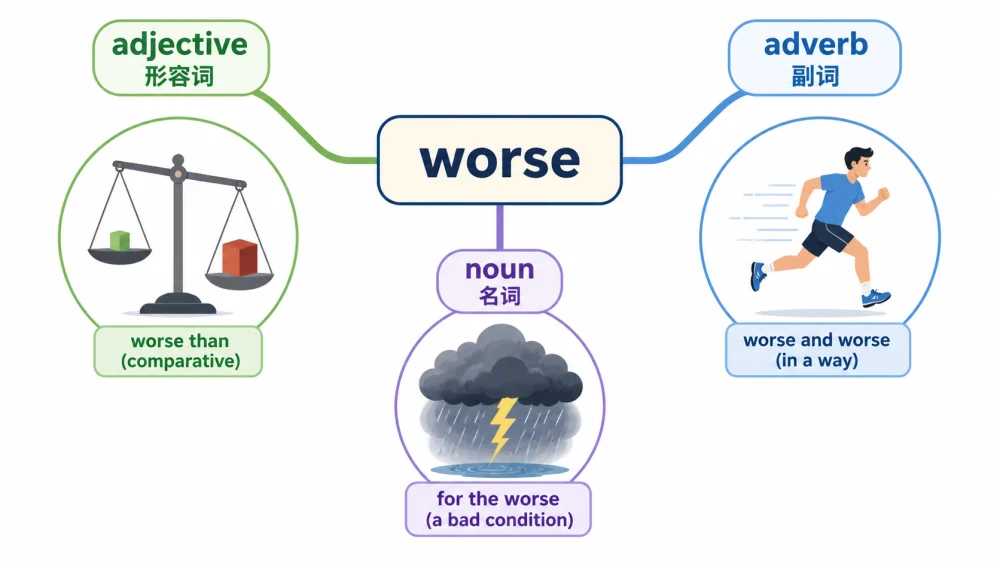
You look up "worse" and get a list of synonyms—"more bad," "more severe," "inferior"—and still aren't sure which one fits your sentence. Here's the short answer: worse plays three different grammatical roles (adjective, adverb, and noun), and the right meaning depends entirely on which role it's filling. Get that wrong, and your sentence sounds off even if every other word is correct.
Your dictionary only told you half the story
Open the Cambridge Dictionary entry for "worse" and you'll see several definitions listed side by side, separated by semicolons, as if you can just grab whichever one feels right.
In practice, though, the distinctions matter. "His condition is worse" and "his condition is more serious" feel different in a medical context. "The movie was worse than the book" and "the movie was more disappointing than the book" carry slightly different weight. The reason worse keeps slipping through your fingers is that it's doing three different jobs depending on the sentence—and most dictionary pages don't separate those jobs clearly.
The foundation: "worse" is the comparative of "bad," not "badder"
Start here. Worse is pronounced /wɜːrs/, and it serves as the comparative form of three separate words: bad (adjective), badly (adverb), and ill (adjective meaning sick). Three different words, one shared comparative—that's unusual even by English standards.
You might wonder why English doesn't just use badder. The reason is that worse and bad don't share the same root. Worse descends from Old English wyrsa, a completely separate word that merged with bad over centuries of language evolution. That irregular pattern is why native speakers never say badder—the word simply doesn't exist in standard English.
Role 1: "Worse" as an adjective
As an adjective, worse modifies a noun or follows a linking verb. This is its most common role, but the right synonym depends on what you're describing.
Comparing quality: use "lower quality" or "inferior"
When you're comparing two things head-to-head on quality, worse means inferior or lower in quality.
- The film is worse than the book. (The book is better; the film doesn't measure up.)
- She's even worse than me at swimming. (Her swimming skills are lower than mine.)
Describing a deteriorating situation: use "more severe" or "more serious"
When worse describes a condition, circumstance, or state of affairs, it signals that things have deteriorated.
- The conditions are worse than we thought. (The situation has declined beyond expectations.)
- And to make matters worse... (A fixed phrase meaning "adding to the problem...")
Describing health: "worse" almost always means "more serious"
This is where students and non-native speakers most often stumble. When someone is physically unwell, saying they're "more bad" sounds wrong because it is wrong in that context. Native speakers say the condition is more serious or that the illness has worsened.
- He's worse than he was yesterday. (His condition has declined since yesterday.)
- My cold seems to be getting worse. (The cold is progressing, becoming more severe.)
In a medical context, getting worse is the natural phrasing—equivalent to saying a condition is deteriorating or progressing. If you told a doctor "I feel more bad today," you'd be understood, but every native speaker in the room would notice.
Role 2: "Worse" as an adverb
As an adverb, worse modifies a verb or another adjective. The tricky part is that you can't just swap in "more badly" and call it done—the phrasing shifts depending on what verb it's attached to.
Modifying performance or behavior
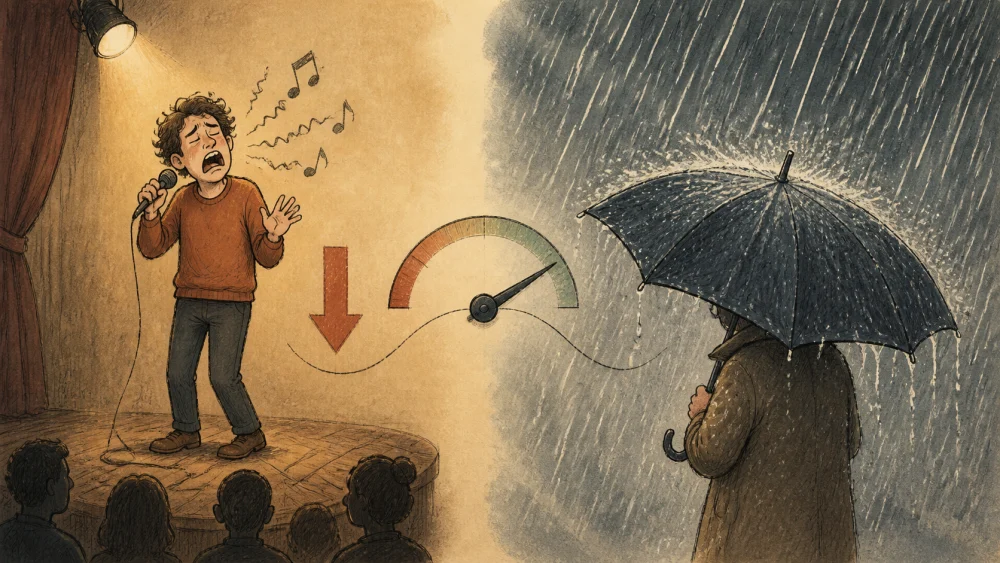
- He sings worse than you. (His singing is of lower quality than yours.)
- The interview could not have gone worse. (It was as bad as an interview can possibly be.)
Notice how "he sings worse" feels natural, while "he sings more badly" sounds stiff. In spoken English, worse is almost always preferred over more badly in these constructions.
Modifying degree or intensity
This is where direct translation instincts break down most dramatically.
- It's raining worse than ever. (The rain is heavier than it has ever been.)
- It hurts worse than yesterday. (The pain is more intense than it was yesterday.)
In both sentences, worse is intensifying the action—heavier rain, stronger pain. The word isn't describing something as "more bad" in a moral or quality sense; it's marking an increase in degree. Pay attention to the verb when you encounter worse as an adverb, and let the verb guide your interpretation.
Role 3: "Worse" as a noun
Here's the part most learners never encounter: worse can function as a noun, meaning "a worse situation" or "something more unpleasant." It acts as the subject or object of a sentence.
- There is worse to come. (Something more unpleasant will happen later.)
- Prison, or worse. (Imprisonment—or an even more severe outcome.)
The most common noun use is the fixed phrase for the worse, meaning "in a negative direction." For example: Things changed for the worse. Cambridge Dictionary gives this phrase its own entry, which tells you how frequently it appears in real usage.
Most grammar guides skip noun worse entirely. But if you're reading long-form journalism or literary fiction and you see worse sitting where a noun should be, now you'll know exactly what it's doing.
Quick-reference: 6 common "worse" collocations
Knowing the three roles covers the grammar. Knowing the collocations covers real-world usage. These six phrases cover the vast majority of situations where you'll encounter worse:
get worse — to deteriorate. The traffic gets worse every summer.
make worse — to cause further deterioration. Don't make things worse by arguing.
for the worse — in a negative direction. His attitude changed for the worse after the promotion.
worse off — in a more difficult or less favorable position. We'd be no worse off without the subscription.
none the worse — unaffected; no worse than before. She was none the worse for the fall.
could be worse — an expression meaning the situation is acceptable, if not good. The result could be worse—at least we didn't lose money.
One worth memorizing: none the worse means the opposite of what it looks like at first glance. It signals that something bad happened but caused no lasting harm. Don't read it as a negative intensifier.
"Worse" vs. "worst": comparative vs. superlative
Worse compares two things. Worst picks the lowest point out of three or more.
- This year is worse than last year. (Two years, one comparison.)
- This is the worst year in a decade. (One year ranked against nine others.)
The rule is simple: if you're comparing exactly two things, use worse. If you're ranking three or more—or emphasizing the absolute bottom—use worst. On standardized tests, count the items being compared before you choose.
"Worse" vs. "worsen": adjective/adverb vs. verb
Worsen is a verb meaning "to become worse" or "to make worse." It's easy to confuse with worse in complex sentences.
- The weather worsened overnight. (Worsened is the verb; it's the main action of the sentence.)
- Worse weather is expected. (Worse is the adjective; it modifies "weather.")
When you need a verb, use worsen. When you need an adjective or adverb, use worse. Mixing them up isn't just a grammar error—it changes the structure of the sentence entirely.
Key Takeaways
- Worse has three grammatical roles: adjective, adverb, and noun. Each one behaves differently.
- As an adjective, context determines the best synonym: inferior for quality, more serious for health, more severe for situations.
- As an adverb, let the verb guide you—worse intensifies the action rather than labeling it "more bad."
- As a noun, worse appears in fixed phrases like for the worse and there is worse to come.
- Worse = comparative (two things). Worst = superlative (three or more).
- Worsen is a verb; worse is not. They're not interchangeable.
FAQ
What does "worse" mean?
Worse is the comparative form of bad, badly, and ill. It means "more bad," "more severe," or "more serious," depending on context. As an adjective it can describe lower quality, a deteriorated situation, or a health decline; as an adverb it intensifies a verb; as a noun it refers to a more unpleasant outcome.
What's the difference between "worse" and "worst"?
Worse is the comparative form, used when comparing exactly two things. Worst is the superlative, used when picking the lowest point out of three or more options—or emphasizing an absolute extreme. Example: worse than yesterday vs. the worst day of my life.
How do you use "get worse" in a sentence?
Get worse means to deteriorate over time. In a health context: Her symptoms got worse by evening. For a general situation: The traffic gets worse every year. For weather: Conditions are expected to get worse before the weekend.
Can "worse" be used as a noun?
Yes. As a noun, worse means "a more unpleasant situation or outcome." Common examples include for the worse (meaning "in a negative direction") and there is worse to come (meaning "something even more unpleasant will follow").
Why is the comparative of "bad" not "badder"?
Because worse and bad have different etymological roots. Worse comes from Old English wyrsa, while bad developed separately. Over centuries of use, worse became the established comparative for bad, badly, and ill. English kept the irregular form rather than regularizing it, which is why badder isn't standard English.