
Most people look up "dictate," see "speak aloud" or "give orders," and close the tab. That's a mistake. The word carries five meaningfully different definitions — and mixing them up in writing, translation, or contract review can cost you. According to the Cambridge Dictionary entry for dictate, the verb alone has three distinct senses before you even get to the noun forms.
Dictate as a Verb vs. a Noun: Two Very Different Words
Dictate works as both a verb and a noun, and the meanings across those two roles barely overlap. Most people memorize one or two of the verb senses and skip the noun entirely — which is exactly why the word keeps tripping them up in news articles, academic writing, and legal documents.
Start with the verb. It has three faces.
Verb Sense 1: To Speak Aloud for Someone Else to Write Down
This is the word's oldest, most literal meaning. One person speaks; another records. Think of an executive reading a letter aloud while an assistant types every word — that's dictate a letter.
Example: She dictated a memo to her assistant.
This is the sense most people learn first, and it's the one that shows up in entry-level vocabulary lists. Nothing wrong with knowing it. But stopping here leaves you flat-footed in most real-world contexts.
Verb Sense 2: To Lay Down Rules or Orders with Authority
The Cambridge Dictionary marks this sense as C1 — upper-intermediate to advanced. Here, "dictate" means issuing commands or requirements from a position of authority. Two sentences that illustrate how different this feels from sense 1:
The rules dictate that only running shoes may be worn on the track.
He disagrees with the government dictating what children are taught in schools.
In both cases, "dictate" means "prescribe" or "determine by authority" — not "speak aloud." Swapping in the first definition would produce nonsense. Context is everything.

Verb Sense 3: To Force or Determine an Outcome (The One You're Probably Missing)
This is the sense that catches even advanced readers off guard. Here, "dictate" means that some external force — a circumstance, a situation, a need — compels a particular result. No person is giving orders. No one is speaking aloud. Instead, conditions are doing the driving.
Cambridge's own example sentence nails it: I wanted to take a year off, but my financial situation dictated that I got a job.
Another: The party's change of policy has been dictated by its need to win back younger voters.
"Dictated" here translates most naturally as "forced," "determined," or "required." Rendering it as "commanded" or "spoke aloud" would be absurd. This sense dominates business journalism and academic writing, yet it rarely gets explicit attention in school curricula.
Dictate as a Noun: Directives and Principles
Once you move past the verb, the noun form takes you somewhere else again.
As a noun, "dictate" refers either to a concrete directive or, in a more formal register, to an abstract guiding principle or internal standard.
The Dictates of Conscience — A Principle, Not an Order
You'll run into the phrase the dictates of conscience in literature, political essays, and legal arguments. It doesn't mean "commands issued by your conscience" in a military sense. It means the standards or requirements your conscience sets for you — closer to "what your conscience demands" than "orders from above."
The same structure appears in the dictates of fashion (the standards set by fashion trends) and the dictates of common sense (what common sense requires). In these fixed phrases, "dictates" describes an internal or cultural driving force, not an external authority barking instructions.
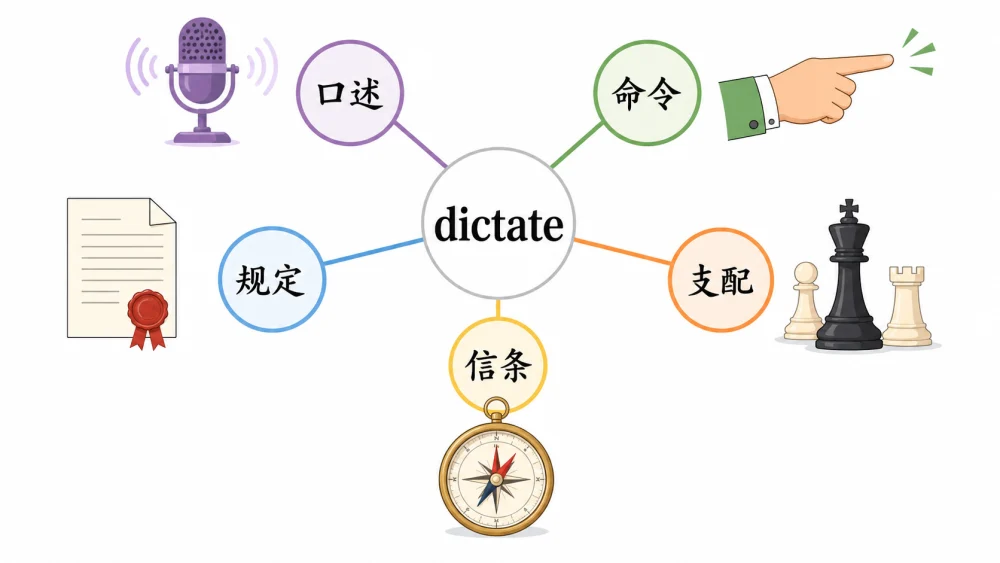
All Five Meanings at a Glance
A Quick-Reference Chart for Choosing the Right Sense
| Part of Speech | Context | Meaning | Signal Words |
|---|---|---|---|
| Verb | Speaking for transcription | To speak aloud, to read aloud | dictate a letter/memo |
| Verb | Authority issuing rules | To prescribe, to determine | dictate the terms |
| Verb | External forces at work | To force, to require, to determine | situation dictated that... |
| Noun | Concrete directive | Order, directive | follow the dictates of |
| Noun | Abstract principle | Principle, standard | dictates of conscience |
Next time you see "dictate," don't reach for "speak aloud" automatically. Scan the subject and the surrounding words, match them to this table, and you'll land on the right reading every time.
The Pattern Most Readers Overlook
"Dictate That..." With a Non-Human Subject Almost Always Means Sense 3
Here's a practical shortcut worth memorizing. When you see "dictate that..." and the subject is an abstract noun — circumstances, the situation, necessity, the economy — it's the third verb sense nearly 100% of the time.
That rules out "speak aloud" and "give orders" immediately. No circumstance speaks, and no situation holds a rank. The word is telling you that conditions made something happen.
Breaking Down a Real Sentence
Take: My financial situation dictated that I got a job.
- Subject: my financial situation — not a person
- Verb: dictated (past tense)
- That-clause: that I got a job
A financial situation can't talk, and it can't issue orders. What it can do is leave you no realistic alternative. That's sense 3. The only accurate reading is "forced me" or "meant I had to."
This sense appears constantly in financial reporting and policy analysis — phrases like "market conditions dictated the decision" are standard fare. But because most English classes introduce dictate only as "speak aloud; give orders," readers hit these sentences and stall.
Dictate vs. Demand vs. Command: How Strong Is the Word?
Ranking Three Close Synonyms by Force and Context
All three can be translated loosely as "order" or "require," but they occupy different points on the authority spectrum.
Command is the strongest. It carries military or absolute-authority connotations — generals command troops, and failing to comply has formal consequences. Use it when the relationship involves hierarchy with teeth.
Dictate lands just below that. The emphasis is on unilateral control: "I set the terms and you follow them." It implies someone — or something — is calling all the shots. Slightly more controlling than demanding, slightly less absolute than commanding.
Demand is the least forceful of the three. You can demand a raise without having any power to compel your employer. The word is about strong insistence, not authority. Anyone can demand anything.
A useful mental shortcut: command looks at rank, dictate looks at control, demand looks at attitude.
Common Collocations and What They Actually Mean
Dictate Terms / Dictate Policy / Dictate a Letter
Dictate terms (set or impose the terms): standard in negotiation and contract contexts. The winning side will dictate the terms of the settlement. Here it means "determine and impose," not "read aloud."
Dictate policy (drive or determine policy): common in political reporting. This leans toward sense 3 — external pressures or dominant actors shaping outcomes, not someone reciting policy into a recorder.
Dictate a letter (read a letter aloud for transcription): the original sense, alive and well in administrative and legal contexts where precise word-for-word records matter.
Dictate to someone (tell someone what to do in a controlling way): notice the preposition "to." This phrasing carries a negative charge — it implies the person on the receiving end didn't agree to be controlled. Don't let anyone dictate to you how to run your own business.
According to the WordReference English dictionary, when "dictate" appears in contexts involving rules or contractual terms, "prescribe" or "set" is typically the closest equivalent — not "command." That distinction matters enormously in legal and business writing, where word choice carries weight.
FAQ
What's the difference between "dictate" and "dictation"?
"Dictation" is a noun. It refers to the act of speaking aloud for someone to transcribe, or to the resulting text. Take dictation means to write down what someone is saying. "Dictate" as a verb covers that same action but extends to three other senses. As a noun, "dictate" covers abstract principles and directives, which "dictation" doesn't.
How is "dictator" related to "dictate"?
"Dictator" adds the Latin agent suffix -or to "dictate," making it "one who dictates." The root is the Latin dict-, meaning "to say." The path from "one who says what goes" to "an authoritarian ruler" is fairly direct. The same root gives English predict (say in advance), contradict (say against), and verdict (say what is true).
How do you pronounce "dictate" in American vs. British English?
In American English, the stress falls on the first syllable: /ˈdɪk.teɪt/. In British English, the stress shifts to the second: /dɪkˈteɪt/. This is one of the cleaner examples of stress-pattern differences between the two dialects. The vowels and consonants are the same — just the emphasis changes.