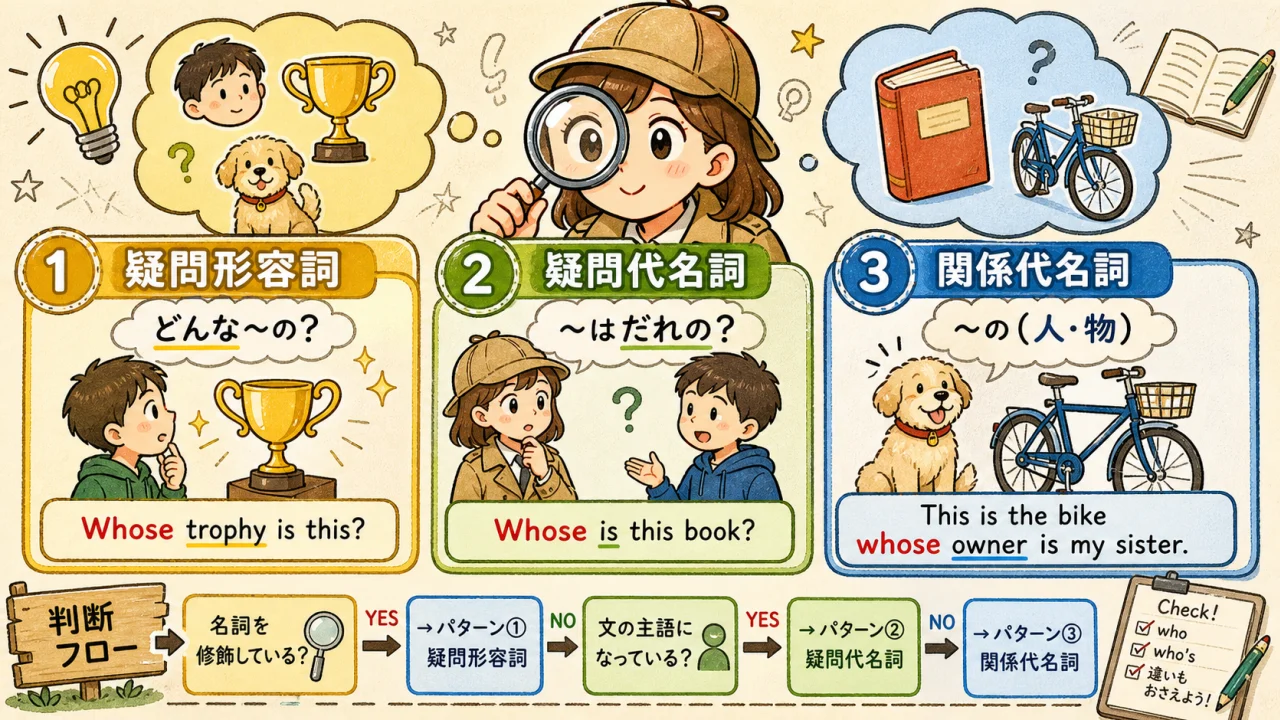
If "whose" keeps tripping you up on tests or in writing, you're not alone — and the fix is simpler than you think. "Whose" has three distinct jobs in English, and most confusion comes from only learning one of them. This guide maps out all three patterns so you can use "whose" correctly every time.
Why "Whose = of whom" Isn't Enough
"Whose" is the possessive form of "who," sitting in the same family as "my," "her," and "their." But the way you build a sentence with it changes completely depending on context.
Compare these two:
- "Whose bag is this?" — a question you'd learn in middle school.
- "I have a friend whose mother is a famous writer." — a relative clause from a high school grammar unit.
Same word. Totally different structure and function. If you only know "whose" as a question word meaning "belonging to whom," the second sentence will stop you cold. Let's fix that by walking through each pattern one at a time.
Pattern 1: Interrogative Adjective — "Whose + Noun + Verb?"
This is the most common use you'll encounter. You place "whose" directly before a noun to ask who owns something.
- Whose bag is this?
- Whose car is parked in the driveway?
The key rule: a noun must immediately follow "whose." You can't write "Whose is bag this?" — the noun sticks right to "whose" as a unit at the front of the question.
When you answer, you have two options. You can use a possessive adjective plus a noun ("It's my bag.") or a possessive pronoun alone ("It's mine."). The difference matters: "my" needs a noun after it, while "mine" stands on its own. Standardized tests and classroom quizzes love to test exactly this pair, so memorize them together.
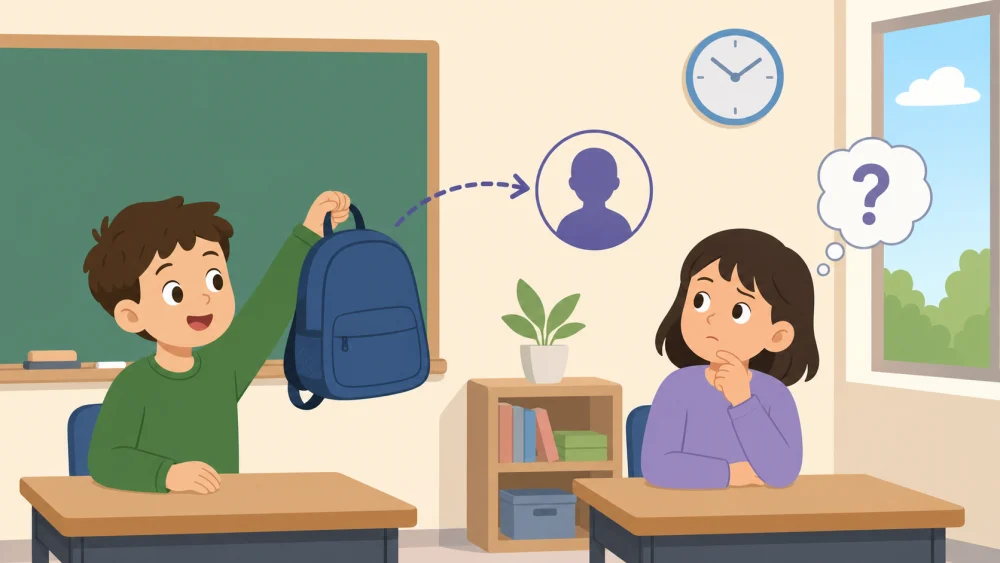
Pattern 2: Interrogative Pronoun — "Whose is this?" (No Noun Attached)
"Whose" can also stand alone — no noun attached — when the object in question is already obvious from context.
- Whose is this book?
- I found some keys on the counter. Whose are they?
"Whose book is this?" and "Whose is this book?" mean the same thing. Pattern 1 (with the noun) is far more common in both conversation and on tests, but Pattern 2 shows up naturally when pointing at something right in front of you and the noun would feel redundant.
Quick test tip: look at what comes immediately after "whose" in a fill-in-the-blank question. If there's a noun, you're in Pattern 1. If there's a verb or nothing, you're in Pattern 2. That one check is usually all you need.
Pattern 3: Relative Pronoun — Joining Two Sentences into One
This is where most learners hit a wall. "Whose" doesn't just ask questions — it also works as a relative pronoun that connects two clauses by showing possession.
When the Antecedent Is a Person
The antecedent is the noun that "whose" refers back to. Start with two separate sentences:
- I have a friend.
- Her mother is a famous writer.
"Her" is a possessive. Replace it with "whose" and merge:
- I have a friend whose mother is a famous writer.
One more example to make the structure stick:
- The student whose notes I borrowed always sits in the front row.
Notice that even in relative clauses, "whose" is still followed by a noun ("mother," "notes"). That pattern holds across all three uses.
When the Antecedent Is a Thing or Animal
Here's something most grammar guides bury in a footnote: "whose" doesn't require a human antecedent. It works fine with objects and animals too.
- The house whose roof is white belongs to my uncle.
- We rescued a dog whose leg had been broken in two places.
In formal written English, you can swap "whose" for "of which" when the antecedent is a thing — "the house the roof of which is white" — but that construction sounds stiff in almost any modern context. Stick with "whose" and your writing will read more naturally.
Decision Flowchart: Which Pattern Are You Looking At?
Two steps cover the vast majority of cases:
Step 1: Is the sentence a question?
- Yes → look at what follows "whose."
- Noun right after → Pattern 1 (interrogative adjective)
- No noun right after → Pattern 2 (interrogative pronoun)
- No → it's a relative clause → Pattern 3
Step 2 (for fill-in-the-blank problems): Check what comes right after the blank.
- Noun → the answer is "whose"
- Verb → the answer is "who"
For example: "I have a friend ( ) mother is a famous writer." The word after the blank is "mother" (a noun), so the answer is "whose." But "There are students ( ) don't speak Spanish." has a verb right after the blank, so the answer is "who." This single check — noun or verb after the blank — is the fastest way to distinguish relative "whose" from relative "who" on any test.
Don't Mix Up "Whose," "Who," and "Who's"
"Who" (Subject Pronoun) vs. "Whose" (Possessive)
"Who" acts as the subject of a clause — it means "the person that" does something. "Whose" shows ownership.
- There are a lot of visitors who don't speak English. → "who" is followed by a verb ("don't speak")
- I have a friend whose mother is a famous writer. → "whose" is followed by a noun ("mother")
"Who's" (Contraction) vs. "Whose" (Possessive)
"Who's" is a contraction of "who is" or "who has." It sounds identical to "whose," but the two are not interchangeable.
- Whose book is this? ✓
- Who's book is this? ✗ — this would mean "who is book is this," which makes no sense.
When you're unsure while writing, try replacing the word with "who is." If the sentence still makes sense, use "who's." If it falls apart, use "whose."
Practice Examples by Pattern
Work through these yourself — try to identify which pattern each one is before reading on. That active step builds the instinct faster than passive reading.
Pattern 1 — Interrogative Adjective (classroom setting)
- Whose pencil is on the floor?
- Whose homework did the teacher collect first?
Pattern 2 — Interrogative Pronoun (everyday conversation)
- There are three jackets by the door. Whose are they?
- Whose is this water bottle?
Pattern 3 — Relative Pronoun (writing and reading)
- The kid whose hobby is playing guitar won the school talent show.
- The bicycle whose handlebars were bent needs to go to the shop.
The Blind Spot That Trips Up Even Careful Learners
Most people who study "whose" learn the "whose + noun" pattern and stop there. That's enough for straightforward sentences — but what happens when the antecedent and "whose" aren't sitting next to each other?
Look at this sentence: "There is a big house near the station whose wall is painted red."
The word right before "whose" is "station," but a station doesn't have a wall in this context. The actual owner of the wall is "a big house." A prepositional phrase ("near the station") has slipped between the antecedent and the relative clause.
The fix: don't automatically grab the noun closest to "whose" as the antecedent. Ask yourself, "What logically owns the thing described after 'whose'?" Whose wall? The house's. Work backwards from meaning, not just word order.
FAQ
What's the difference between "who" and "whose"?
"Who" is a subject pronoun ("the person who did it"), while "whose" is possessive ("the person whose idea it was"). If the word after the blank is a verb, choose "who." If it's a noun, choose "whose."
Can "whose" refer to things, not just people?
Yes. "Whose" works with animals and inanimate objects as antecedents — for example, "a car whose engine keeps stalling." In very formal writing you might see "of which" instead, but "whose" is standard and natural in most contexts.
Is "Whose is this?" correct English?
Completely correct. It's the interrogative pronoun use of "whose" (Pattern 2). "Whose bag is this?" (Pattern 1) is more common, but both are grammatically sound. The choice comes down to whether the noun is obvious enough from context to leave out.
When should I use "whose" versus "of which"?
When the antecedent is a thing, you can technically use either: "the building whose roof collapsed" or "the building the roof of which collapsed." Both are correct, but "of which" reads as formal or even archaic in most modern writing. Unless you're drafting a legal document or academic paper that calls for elevated register, "whose" is the better choice.