You know the word "dictate," but putting it into a sentence feels awkward. That's because "dictate" carries three separate meanings as a verb—and shifts its pronunciation entirely when used as a noun. Sort out which meaning you need first, and using dictate in a sentence stops being a guessing game. The 14 examples below cover every major context so you can see exactly how it works.

Key Takeaways
- "Dictate" functions as both a verb (dic-TATE) and a noun (DIC-tate), with stress shifting between them.
- As a verb, it means to speak aloud for transcription, to give orders, or to determine an outcome.
- The preposition you attach—"to," "that," or none—changes what the sentence means.
- Mixing up "dictate" with "dedicate" or "indicate" is one of the most common errors, especially in student writing.
What Does "Dictate" Actually Mean?
Dictate (verb, /dɪkˈteɪt/): to speak words aloud for someone else to write down; to command with authority; or to control or determine an outcome. As a noun (/ˈdɪk.teɪt/), it means an authoritative order or guiding principle. The word came into English from the Latin dictāre around the 1590s.
Three Distinct Verb Meanings
Most vocabulary references give one definition and move on—which is exactly why "dictate" causes so much confusion. Here's what the word actually does as a verb:
- Speak aloud for transcription. A manager dictates a memo while an assistant types it. Before email, this was a daily office routine—and "dictation" still shows up on spelling tests throughout American elementary schools.
- Give orders or impose rules. A government dictates new trade policy. The tone is commanding, often with a negative undertone.
- Determine or control an outcome. Weather dictates whether the game gets played. No authority figure is involved; circumstances do the dictating.
Three meanings, one word. Getting clear on which one you need before you write saves you a lot of revision.
Dictate as a Noun (and Why the Stress Shifts)
When "dictate" becomes a noun, the stress moves to the first syllable: DIC-tate. You'll hear it in phrases like "the dictates of fashion" or "moral dictates." This stress shift follows the same pattern as other English verb-noun pairs—"record" (re-CORD vs. REC-ord) or "permit" (per-MIT vs. PER-mit). Around 80 such pairs exist in standard American English, and "dictate" is one of the trickier ones because the noun form almost never comes up in everyday conversation.
14 Examples of Dictate in a Sentence by Context
Formal and Business Sentences (Examples 1–5)
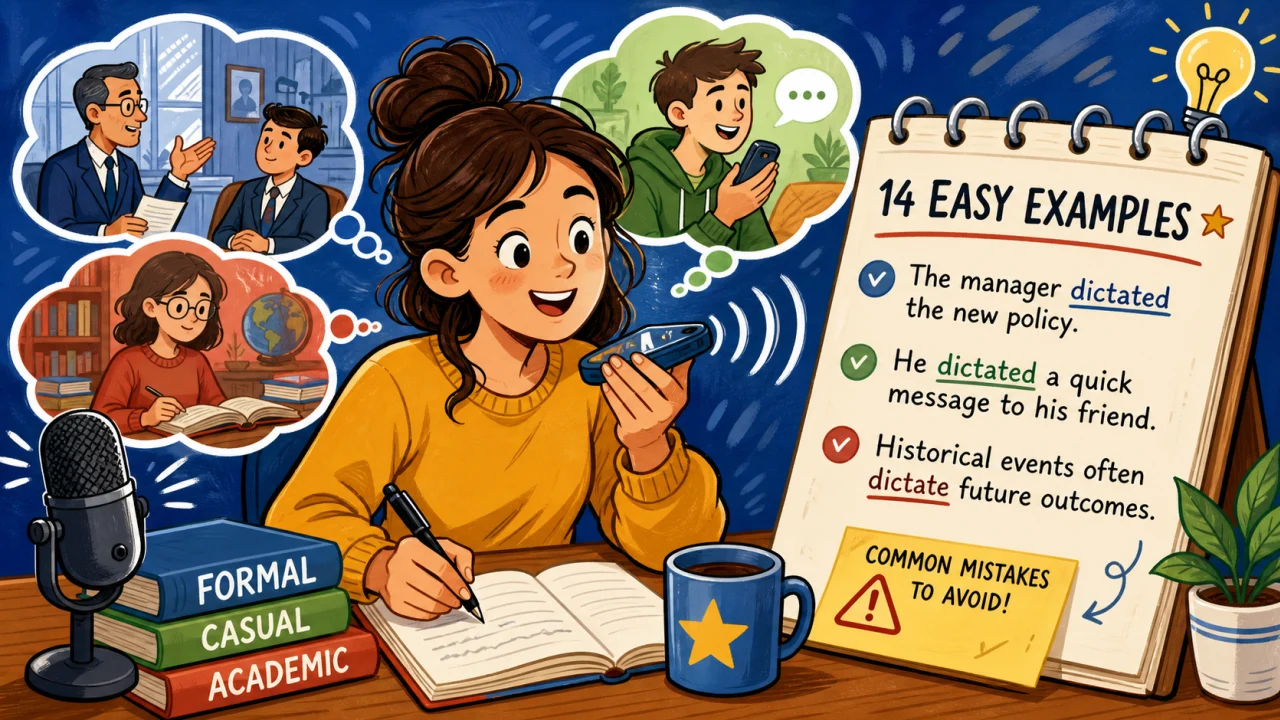
- The manager will dictate the quarterly report to her assistant before the Friday deadline.
- Company policy dictates that all expense claims must include a receipt dated within 30 days.
- The board refused to let a single investor dictate the direction of the merger.
- Federal regulations dictate how pharmaceutical companies label prescription drugs.
- She asked the attorney to dictate the contract terms into a voice recorder for later review.
Examples 1 and 5 use the "speak aloud" meaning. Examples 2 and 4 use "determine." Example 3 uses "command." Same word, three different jobs.
Casual and Everyday Sentences (Examples 6–9)
- Don't let one bad grade dictate how you feel about the whole semester.
- The weather is going to dictate whether we have the cookout on Saturday or push it to Sunday.
- My older brother always tries to dictate what movie we watch on family night.
- You can't dictate someone's taste in music—people like what they like.
Casual sentences almost always lean on the "control" or "command" meanings. The "speak aloud" sense sounds stiff in everyday talk, which is why you won't hear it at a backyard barbecue.
Academic and Essay Sentences (Examples 10–14)
- Economic conditions in the 1960s dictated the fiscal policies that shaped the following decade.
- The researcher argued that genetics alone should not dictate educational expectations for children.
- Cultural norms dictate which behaviors a society considers acceptable.
- The professor dictated a series of key terms so students could practice spelling them correctly.
- Historical precedent dictates that rapid inflation tends to follow prolonged deficit spending.
Academic writing gravitates heavily toward the "determine" meaning. Scholarly arguments focus on cause and effect, and "dictate" fits that framing cleanly.
Why "Dictate" Trips Up So Many Writers
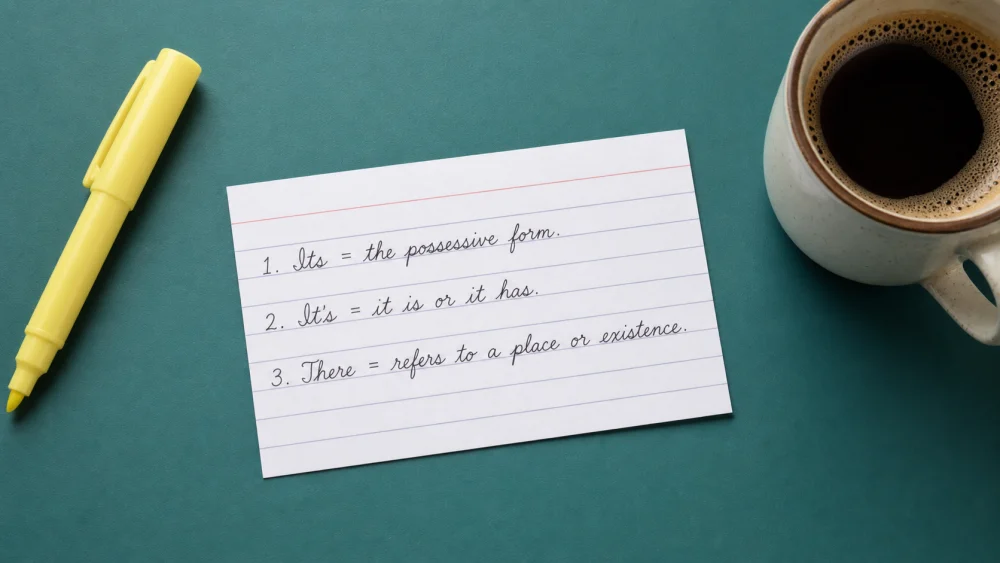
Confusing Dictate With Dedicate or Indicate
These three words look similar on the page, and autocorrect doesn't always catch the swap. Here's a quick test: if you can substitute "command" or "determine" and the sentence still holds, you want "dictate." If you mean "devote," that's "dedicate." If you mean "show" or "point out," that's "indicate." A 1968 study of college freshman essays at the University of Michigan flagged "dedicate/dictate" confusion among the top 25 vocabulary mix-ups for native English speakers—so you're in good company if this has caught you before.
Using the Wrong Preposition After Dictate
This is the subtle one. "Dictate to someone" means you're giving them orders. "Dictate that something happen" sets up a clause describing the rule or result. Drop the preposition entirely when "dictate" means "determine": The market dictates the price. Adding "to" there (The market dictates to the price) sounds wrong because it is wrong.
Dictate vs. Dictate To vs. Dictate That: Quick Cheat Sheet
- Dictate + direct object: The schedule dictates our routine. (Meaning: determines)
- Dictate to + person: You can't dictate to me what I should wear. (Meaning: give orders)
- Dictate that + clause: The law dictates that employers provide a safe workplace. (Meaning: requires)
Lock in these three patterns and you'll handle roughly 95% of the situations where "dictate" appears in written American English.
How to Choose the Right Form for Your Sentence
Step 1: Decide If You Mean Command, Speak Aloud, or Determine
Ask yourself one question before writing: Who or what is doing the dictating? A person giving orders? That's the "command" sense. A person reading text aloud for someone else to transcribe? That's "speak aloud." A situation, rule, or condition controlling an outcome? That's "determine." Your answer drives every grammar choice that follows.
Step 2: Match the Grammar Pattern to Your Meaning
Once you've picked the meaning, use the cheat sheet above. "Speak aloud" almost always takes a direct object (dictate a letter). "Command" pairs with "to" plus a person. "Determine" takes either a direct object or a "that" clause. Getting the pattern right is what makes the sentence sound natural instead of awkward.
The Pronunciation Shift Most Sites Don't Mention
Here's something most example-sentence pages skip entirely: "dictate" changes its stressed syllable depending on whether it's a verb or a noun. Say it aloud:
- Verb: dic-TATE (stress on the second syllable). She will dic-TATE the letter.
- Noun: DIC-tate (stress on the first syllable). That's a moral DIC-tate.
If you're prepping for a presentation, a speech class, or a dictation exercise, stressing the wrong syllable will make you sound uncertain—even if the sentence itself is grammatically clean. Read it aloud before you commit.
Practice Drill: Fill in the Blank
Try these on your own before checking the answers in parentheses.
- The coach will ______ the practice schedule for the rest of the season. (dictate)
- You shouldn't let fear ______ your decisions. (dictate)
- The CEO ______ a memo to her assistant every Monday morning. (dictates)
- Social ______ in the 1950s required women to wear gloves to formal events. (dictates — noun form)
If you got all four right, you've got a solid handle on how "dictate" works across its meanings and forms.
FAQ
Can You Start a Sentence With "Dictate"?
Yes. "Dictate" works at the start of a sentence, especially in the imperative form. For example: "Dictate your notes into a recorder so you don't forget them." You can also open with the noun: "Dictates of common sense suggest you save before you spend."
Is "Dictate" a Negative Word?
Not automatically. When it means "speak aloud" or "determine," there's no negative connotation. It only sounds bossy when it means "give orders in a domineering way," as in "He tried to dictate every detail of the project." Context controls the tone, not the word itself.
What Is the Past Tense of "Dictate"?
The past tense is "dictated," and the past participle is also "dictated." Example: "The general dictated the terms of surrender." It follows standard regular-verb conjugation, so there are no irregular forms to memorize.
How Is "Dictate" Used in Legal or Medical Writing?
In legal writing, "dictate" typically means "require": "The statute dictates a minimum sentence of five years." In medical settings, doctors dictate patient notes into a recorder for transcription—a practice that predates electronic health records and still continues in many U.S. clinics today.
What Are Good Synonyms for "Dictate"?
For the "command" meaning, try "decree," "order," or "impose." For "determine," use "govern," "shape," or "control." For "speak aloud," try "recite" or "read aloud." Each synonym carries a slightly different weight, so test it in context before swapping it in.